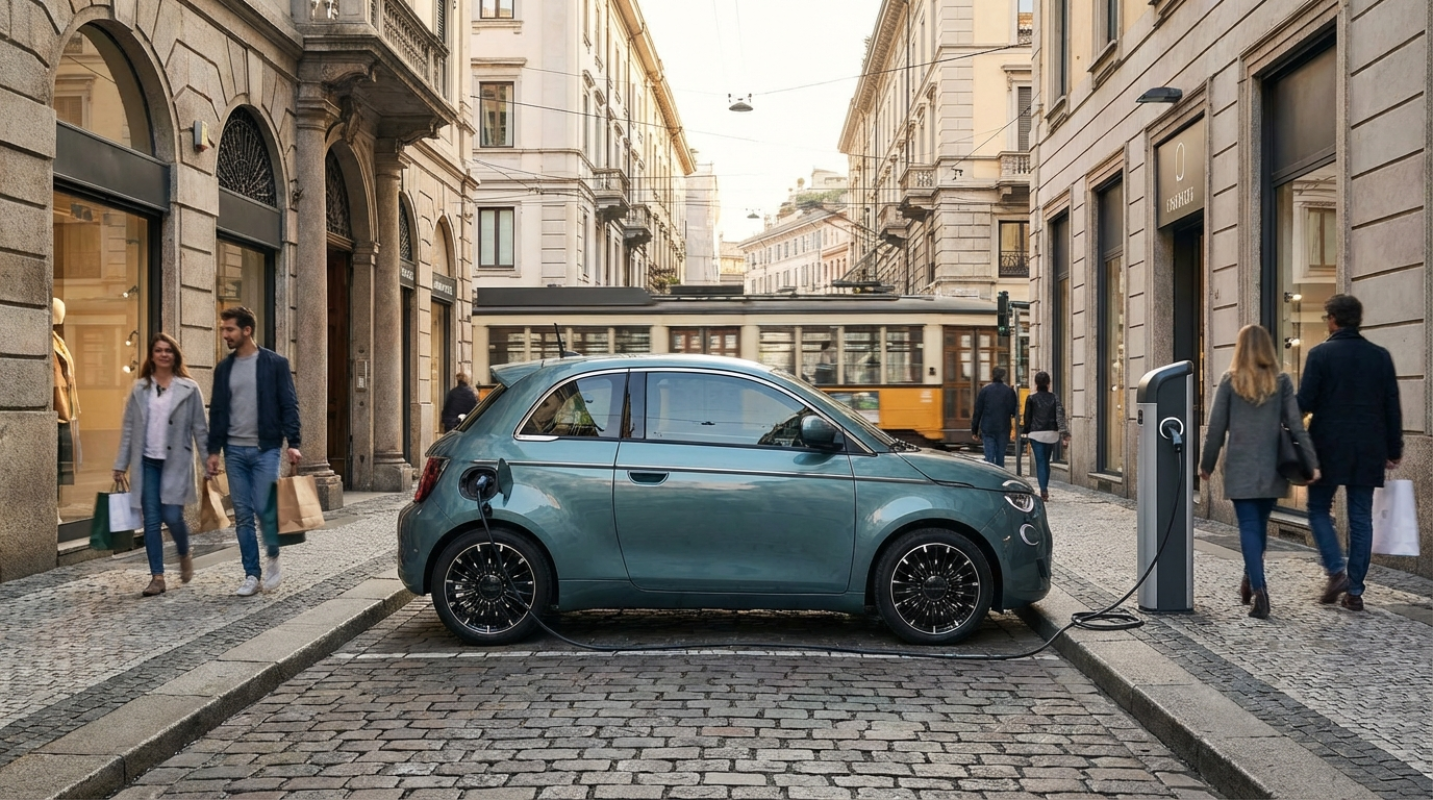
 (Image source: Gemini / Landon Phillips)
 Have you ever spent twenty minutes circling a city block, watching your blood pressure rise while every potential parking spot mocks you by being just six inches too short? You aren't alone. For years, the automotive industry pushed bigger, heavier, and longer vehicles, but as our metropolitan areas get denser, the tide is finally turning. In 2026, the real luxury isn't a massive hood or a third row of seats you'll never use. It's the ability to whip into a tight parallel spot on the first try.
We're seeing a massive shift in what people actually value in a city car. Range anxiety, that old fear of running out of juice on a deserted highway, is being replaced by parking anxiety. If you live in a place like New York, London, or Tokyo, you probably don't need a car that can drive 400 miles without stopping. You need a car that can handle a 10.3 meter turning circle without breaking a sweat.
The current market for sub-compact and micro-EVs has exploded because drivers are waking up to a simple truth. Most urban trips are short, solo, and involve narrow streets. By "right-sizing" the car to the environment, manufacturers are making city life significantly less stressful. It's the difference between trying to handle a crowded sidewalk with a double-wide stroller versus a slim umbrella model. One is a chore, the other is a breeze.
Design DNA, Engineering for Tight Spaces
So what makes a car actually "urban-ready"? It's more than just being short. It's about the ratio of the wheelbase to the total length. When engineers design these compact EVs, they push the wheels out to the absolute corners. This creates a tiny footprint but maintains enough stability to keep the ride from feeling like a lawnmower.
The turning radius is the holy grail here. If you can pull a U-turn on a standard two-lane street without shifting into reverse, you've won the city driving game. Experts generally suggest that for true urban agility, you want a turning circle under 35 feet. Some of the best models, like the Dacia Spring, manage to get that down to a staggering 31.6 feet (9.63 meters).³
Think about the physical footprint for a second. A standard SUV can easily be 190 inches long. Compare that to the Fiat 500e, which sits at just 143.1 inches.¹ That's nearly four feet of difference. In a crowded parking garage, those four feet are the difference between "fitting like a glove" and "blocking the entire ramp while you try to shimmy into a corner spot."
Parking Prowess, Techniques and Technology
Let's talk about the specific magic of parallel parking a micro-EV. You know those awkward half-spots at the end of a row? The ones left over because a Suburban parked poorly? In a compact electric car, those aren't "too small" spots. They're your private VIP parking. Because these cars are so narrow (the Dacia Spring is only 62.3 inches wide), you also get more breathing room on both sides in narrow parking garage stalls.³ No more sucking in your gut just to squeeze out of the door.
The tech side of things has also caught up. Most modern urban EVs come standard with 360-degree cameras and ultrasonic sensors. When you're driving a car that's already tiny, these cameras make you feel like you have a superpower. You can see exactly how many centimeters are between your bumper and the guy behind you. Some models even feature automated parking that can handle the steering and braking for you, which is a lifesaver when you're trying to park while a line of angry taxis honks behind you.
Cities are starting to take notice of this shift too. We're seeing more metropolitan areas adapt their legislation to favor these smaller footprints. Some European cities have already designated "micro-car only" parking zones, and there's a growing movement to base parking fees on vehicle length or weight. It makes sense. If your car takes up half the space of a Ford F-150, why should you pay the same rate?
Performance Profile, City-Specific Range and Charging
You'll often hear critics complain that compact EVs have "small" batteries. But let's look at the math. If your daily commute is 15 miles and you spend most of your time in stop-and-go traffic, why on earth would you want to haul around a massive, heavy 100kWh battery? It's like carrying a gallon of water when you only need a sip.
Smaller batteries are actually an advantage in the city. They make the car lighter, which improves efficiency (Wh/mile). Because they're lighter, they're more responsive when you need to zip into a gap in traffic. In stop-and-go conditions, these cars shine because of regenerative braking. Every time you lift off the pedal, the motor acts as a generator, putting energy back into the battery. It's the digital equivalent of finding five bucks in your pocket every time you hit a red light.
Charging also becomes much simpler with a smaller battery. If you're using a standard Level 2 home charger, you can top off a small EV battery in a few hours rather than overnight. Even better, many of the newer 2025 and 2026 models support high-speed DC fast charging. For a car like the Volvo EX30, you can get from 10% to 80% charge in about 18 minutes. That's barely enough time to grab a coffee and check your emails.
Top Contenders and Modern Urban Mobility
If you're looking to make the jump to a "right-sized" electric life, the options have never been better. Looking back at the sales data from 2025, EVs reached over 10% of the market share, and much of that growth came from people realizing they didn't need a massive tank for city errands.²
1. The Fiat 500e, This is the undisputed king of the tight squeeze. At just 143.1 inches long, it is the shortest EV you can find in many markets.¹ It has a turning circle of 31.8 feet, meaning it can practically spin in place. It's stylish, punchy, and fits into spots that would make a Mini Cooper look bulky.
2. The Renault 5 E-Tech, A new favorite for 2026, this car was built for the narrow streets of Europe. It features a "B-mode" for aggressive regenerative braking, allowing for one-pedal driving. With a 10.3 meter turning circle, it's more agile than almost anything else in its class.
3. The Dacia Spring, If you want the absolute best value-to-size ratio, this is it. It's the narrowest car on the list at just 1,583 mm, making it perfect for those terrifyingly tight parking garage ramps.³ It's lightweight and efficient, focusing on the neededs of city transport without the unnecessary fluff.
4. The Mini Cooper SE, For those who want a bit more "go-kart" feel, the latest electric Mini maintains its iconic handling while upgrading the tech. It’s slightly larger than the Fiat, but it offers a more premium interior and a very sharp OLED display that's perfect for tech-focused drivers.
The future of city driving isn't about more horsepower or bigger screens. It's about reclaiming our streets from oversized vehicles. As we move further into 2026, expect to see even more ultra-compact mobility solutions, from "closed-cabin" electric bikes to even smaller micro-cars. The goal is simple. We want to spend less time worrying about the car and more time enjoying the city. And that starts with a vehicle that actually fits the world it lives in.
Sources:
1. Fiat 500e Technical Specifications