 (Image source: Gemini / Landon Phillips)
 You've probably noticed that every new electric car ad used to brag about 0 to 60 times. It was a bit of a party trick. But let's be honest: how often are you actually pinning your passengers against their seats in a grocery store parking lot? Not often. Now that we're well into 2026, the conversation has shifted. The real luxury isn't how fast you can go: it's how little you feel while you're going there.
Ride quality is that magical mix of isolation from road imperfections, whisper-quiet cabins, and a sense of steady handling that doesn't make you feel like you're on a boat. EVs have a natural head start here. Without a vibrating internal combustion engine or a clunky transmission, the baseline for "smooth" is already much higher than it ever was for gas cars.
But here's the catch. Although noise reduction is relatively easy for an EV, true smoothness is a much harder engineering puzzle. It comes down to how a manufacturer handles the massive weight of those battery packs. If they get it wrong, the car feels heavy and lumbering. If they get it right, they create a "magic carpet" effect that makes a standard luxury sedan feel like a horse and buggy.
The Engineering Advantage: How EVs Achieve Superior Dampening
Think of an EV's battery pack as a heavy anchor sitting right between the wheels. This skateboard chassis design is a huge win for comfort. By keeping all that mass low and centralized, engineers can reduce body roll without needing to make the suspension rock-hard. It gives the car a planted, stable feel that's hard to replicate in a top-heavy SUV.
Most high-end EVs now rely on two main technologies to keep things smooth: air suspension and adaptive dampers. Air suspension replaces traditional steel springs with rubber bladders filled with compressed air. It's like riding on a controlled cushion of atmosphere. It's great for soaking up those high-frequency vibrations from rough pavement that usually buzz through your steering wheel.
Then you have adaptive dampers, sometimes using magnetorheological fluids. That's a fancy way of saying the shocks contain a fluid that gets thicker or thinner when an electric charge is applied. These systems can change their stiffness in a fraction of a second. When you combine a stiff, rigid chassis with these smart suspension systems, you get a car that can isolate you from a pothole before your brain even registers that you hit one.
Top Contenders: Benchmark EVs Setting New Standards for Smoothness
If you're looking for the absolute peak of comfort right now, a few names keep coming up in every expert review. These aren't just cars: they're mobile isolation chambers.
The Ultra-Luxury Tier
The Rolls-Royce Spectre is widely considered the gold standard. It uses what they call a Planar Suspension System. On a straight road, it can actually decouple the anti-roll bars so each wheel can act independently. This prevents the car from rocking when only one side hits a bump. It even uses satellite data to see the road ahead and prep the suspension for upcoming corners.¹
Then there's the Cadillac Celestiq. This car is a tech powerhouse. It uses Magnetic Ride Control 4.0, which can adjust its damping every single millisecond. It also uses active roll control to keep the cabin perfectly level during turns. Cadillac even integrated sensors directly into the ball joints to get more accurate data about what the road is doing.³
The Executive Flagships
The BMW i7 is currently giving the Mercedes EQS a serious run for its money. Although the EQS is famous for its "jelly-bean" smoothness, many drivers prefer the i7 because it feels more composed. It has a two-axle air suspension that automatically levels itself regardless of how much luggage you've crammed into the back.
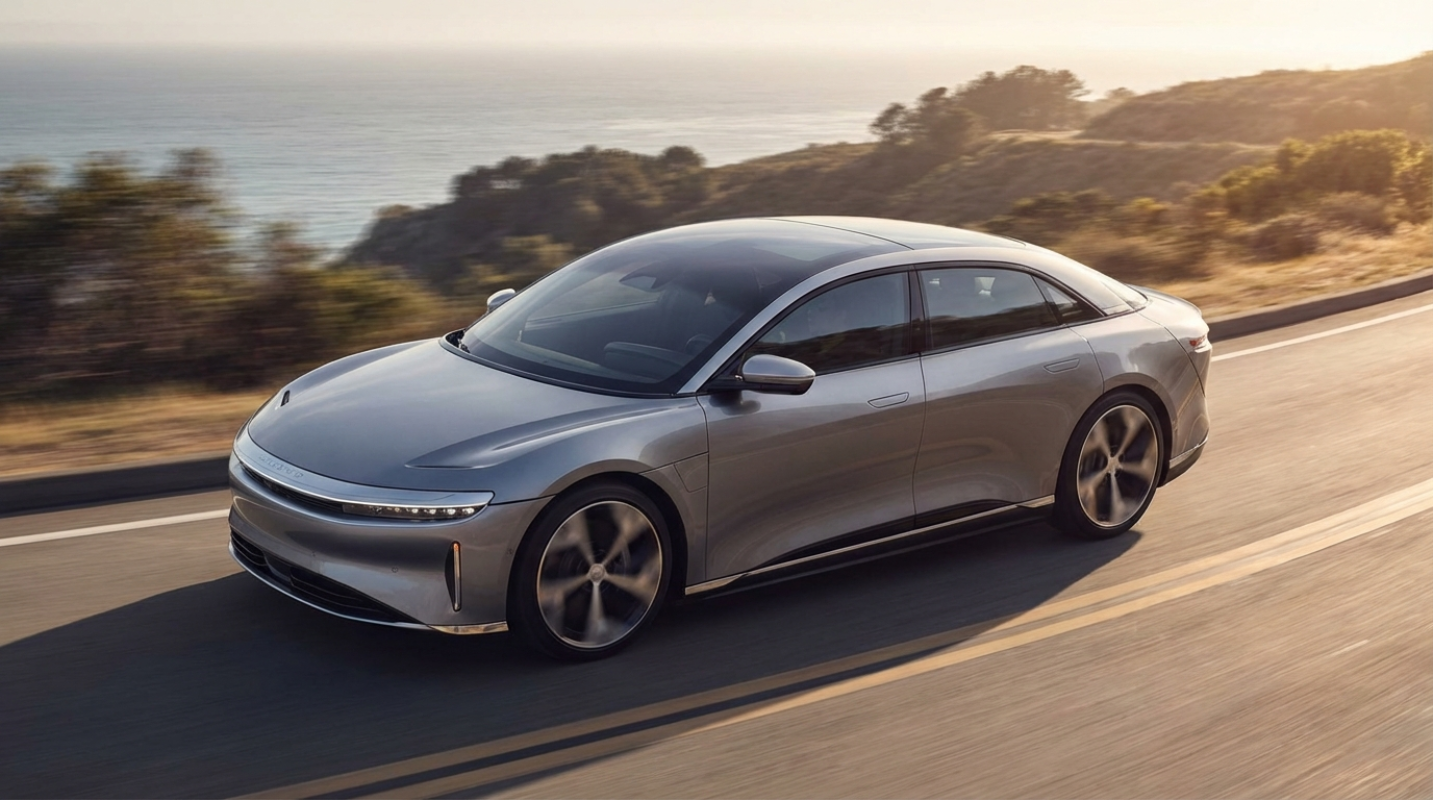
The Lucid Air takes a different path. Instead of air springs, it uses a very sophisticated coil-spring setup in its Pure and Touring trims. It feels more natural and less "floaty" than some of its German rivals. It proves that you don't always need complex air bags to get a world-class ride if your basic suspension geometry is perfect.
Premium SUVs for Families
If you need more space but don't want to sacrifice your spine, the Audi Q8 e-tron is a standout. It comes standard with an adaptive air suspension that can raise or lower the car by three inches. It's often cited as the easiest transition for people moving from a traditional gas luxury SUV because it just feels familiar and incredibly plush.
The Volvo EX90 is another heavy hitter. It uses a dual-chamber air suspension system that adjusts itself 500 times per second. It’s designed to be whisper-quiet, focusing on "Scandinavian calm" rather than sporty handling.
Beyond the Basics: Noise, Vibration, and Harshness in the Electric Age
When you take away the engine noise, every other sound becomes ten times louder. That annoying tire hum? The wind whistling past the mirrors? In an EV, those are the new enemies. This is what engineers call NVH (Noise, Vibration, and Harshness).
To fight back, manufacturers are using acoustic glass, which is basically a sandwich of glass and sound-dampening film. They're also stuffing the wheel arches with foam and using active noise cancellation through the car's speakers. It works just like your favorite pair of noise-canceling headphones, pumping out "anti-noise" to drown out the road.
But smoothness isn't just about what you hear: it's about the "feel" of the ride. Manufacturers are now tuning their cars to be "composed" rather than just "soft." A car that's too soft will bounce around after hitting a bump, which can actually cause motion sickness. The best new EVs hit that sweet spot where the bump is absorbed instantly, and the car returns to a level state immediately.
The Road Ahead for Ultra-Smooth Electric Mobility
What's next for the world of smooth rides? We're already seeing the rise of predictive suspension systems. These use cameras to scan the road surface hundreds of feet ahead. If the car sees a speed bump coming, it can "relax" the suspension a split second before impact so you barely feel it.
We're also looking closely at how solid-state batteries might change things. These batteries are lighter and more energy-dense. If cars get lighter, engineers won't have to fight so much physics to keep the ride comfortable.
The 2025 Porsche Taycan facelift has already given us a glimpse of the future with its Active Ride system. This system is so powerful it can actually make the car lean into corners like a motorcycle or stay perfectly flat during hard braking.⁴ It's not just reacting to the road: it's actively pushing back against it.⁵
As we move further into 2026, the gap between "commuter cars" and "luxury EVs" is mostly being defined by this suspension tech. You can get speed anywhere now. But getting a ride that feels like you're floating on a cloud? That's the real luxury.
Sources:
1. Car and Driver, Rolls-Royce Spectre Review
2. Porsche Newsroom, Porsche Active Ride Technology
3. CarBuzz, Cadillac Celestiq Chassis Tech