 (Image source: Gemini / Landon Phillips)
 You've seen the prices. You've probably walked past a row of gleaming electric vehicles at a dealership and felt that immediate sting of sticker shock. It's a common story in 2026. Although the gap between a battery-powered car and a traditional gas guzzler has narrowed, that initial price tag still feels like a mountain to climb. But is the purchase price the whole story? Not even close.
When you're looking at the true cost of ownership, you have to look past the day you drive off the lot. You need to look at the next five years. This is where the math gets interesting, and honestly, a bit complicated. We're talking about the Total Cost of Ownership (TCO). This includes everything from how much you pay the bank every month to what you’re spending at the "pump" (or the plug) and what your insurance agent thinks of your new ride.
For this breakdown, we're looking at the heavy hitters of the mid-size sedan and SUV world. Think of the battle between a Tesla Model 3 and a Toyota Camry, or a Ford F-150 Lightning versus its gas-burning brother. Over 60 months, the financial picture shifts in ways you might not expect. Does the EV actually save you money, or are you just paying for the privilege of skipping the gas station? Let's get into the weeds.
Upfront Costs and Depreciation: The Initial Hurdle and Long-Term Value
Buying a car in 2026 is a different beast than it was just a few years ago. The average transaction price for an EV currently sits around $55,000 to $57,000. Meanwhile, a comparable gas-powered car will cost you roughly $48,000 to $49,000.⁷ That’s a $7,000 to $9,000 head start for the internal combustion engine (ICE). In the past, you could lean on federal tax credits to bridge that gap. But things changed.
The federal tax credit space hit a wall recently. Following the "One Big Beautiful Bill Act" (OBBBA) in 2025, those juicy $7,500 federal incentives officially expired on September 30, 2025.² Unless you live in a state like Colorado or California that still offers local rebates, you’re likely paying the full freight now. This makes the "upfront hurdle" much higher for new buyers today than it was for the early adopters.
Then there’s the "hidden" cost that most people ignore until they try to sell: depreciation. This is where EVs take a bit of a bruising. Over five years, an EV typically loses about 58.8% of its value. Compare that to a gas car, which loses around 45.6%. Why the difference? It’s the digital equivalent of a smartphone. Battery tech moves so fast that a five-year-old EV can feel like an old iPhone, whereas a gas engine is a known, stable quantity. This depreciation gap can cost an EV owner an extra $10,000 over five years compared to a gas vehicle owner.
Fueling vs. Charging: The Energy Cost Breakdown
This is the part of the conversation where the EV owner usually starts smiling. If you're driving the national average of 15,000 miles per year, the "fuel" savings are massive. For a gas car, you’re looking at an annual bill of roughly $2,220 based on current prices. Over five years, that’s $11,100 literally gone up in smoke.
Now, look at the EV. If you’re charging at home, your annual electricity cost for those same miles is only about $660.¹ That’s a "fuel savings multiplier" that puts $7,800 back in your pocket over five years. It’s like getting a massive raise just for plugging your car in while you sleep.
But there’s a catch. This math only works if you have a home charger. If you rely entirely on public DC fast chargers, your costs can double or even triple, eating into those savings fast. Think of it like this: home charging is like buying groceries and cooking at home, while public charging is like eating out every single night. One is a bargain, the other is a luxury.
Maintenance, Repairs, and Insurance: Hidden and Obvious Expenses
Maintenance is the EV’s strongest play. Think about everything a gas car needs: oil changes, spark plugs, timing belts, transmission fluid, and exhaust systems. An EV has none of that. It’s a much simpler machine. In 2026, the average annual maintenance for an EV is between $400 and $600, while gas cars are still demanding $800 to $1,200 annually.
You also get a boost from regenerative braking. Because the electric motor does most of the slowing down to recapture energy, your physical brake pads can last twice as long as they would on a gas car. It’s a small win, but it adds up. And don't worry too much about the battery dying. Most manufacturers provide an 8-year or 100,000-mile warranty, which covers you well beyond our five-year window.
But insurance is where the "EV advantage" takes a hit. In 2026, EV insurance is roughly 49% more expensive than gas car insurance.³ Why? Because if you get into a fender bender that damages the battery pack, insurers often just "total" the car rather than trying to fix it. Higher repair costs and specialized labor mean you’re paying about $1,300 more per year just to keep the car covered.⁴ Over five years, that’s over $6,600 in extra premiums that many buyers don't see coming.
The Five-Year Verdict: TCO Comparison and Who Wins?
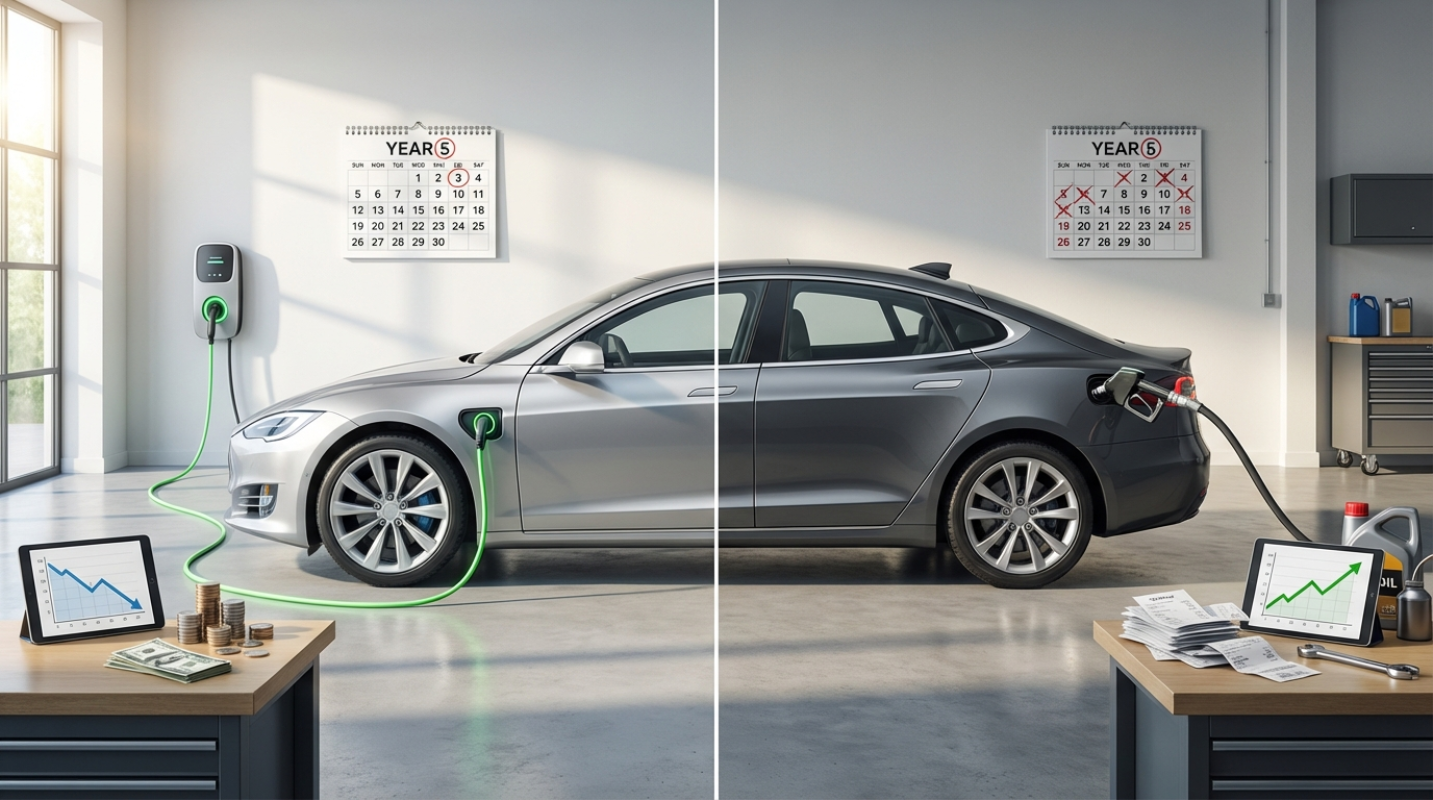
So, what does the final scoreboard look like when we add it all up? Let's break down the total cost of ownership over 60 months for a typical mid-sized vehicle.
- Purchase Price (Avg), EV: $56,000 | Gas: $48,500
- Fuel / Charging, EV: $3,300 | Gas: $11,100
- Maintenance, EV: $2,500 | Gas: $5,000
- Insurance, EV: $20,290 | Gas: $13,660
- Depreciation (Value Lost), EV: $32,000 | Gas: $22,000
- Total 5-Year TCO, EV: ~$74,000 | Gas: ~$67,000
When you look at the raw numbers, the gas-powered car is currently about $7,000 cheaper over a five-year period for the average driver. The combination of higher insurance premiums and steeper depreciation has offset the massive savings found at the charging station.
But wait. This doesn't mean the EV is a bad financial move for everyone. This is a "sensitivity" game. If you drive 25,000 miles a year instead of 15,000, your fuel savings double, and the EV starts to look like a genius move. If you live in a state with high gas prices and low electricity rates, the gap closes even further.
Who benefits most from switching to an EV right now? It’s the high-mileage commuter who can charge at home. If that’s you, the EV is a tool that pays for itself over time. But if you’re a casual driver who only puts 8,000 miles a year on the odometer, the gas car is still the king of the wallet. The "real financial picture" isn't one-size-fits-all. It’s about how you use the tool in your driveway.
Sources:
1. motorwatt.com - EV vs Gas Car Cost
2. edmunds.com - The Ins and Outs of Electric Vehicle Tax Credits
3. aftermarketmatters.com - EVs Cost 49 Percent More to Insure
4. insurify.com - Electric Vehicle Insurance Costs
5. kbb.com - How Much Does an Electric Car Cost?
This article on aidriv.com is for informational and educational purposes only. Readers are encouraged to consult qualified professionals and verify details with official sources before making decisions. This content does not constitute professional advice.