 (Image source: Gemini / Landon Phillips)
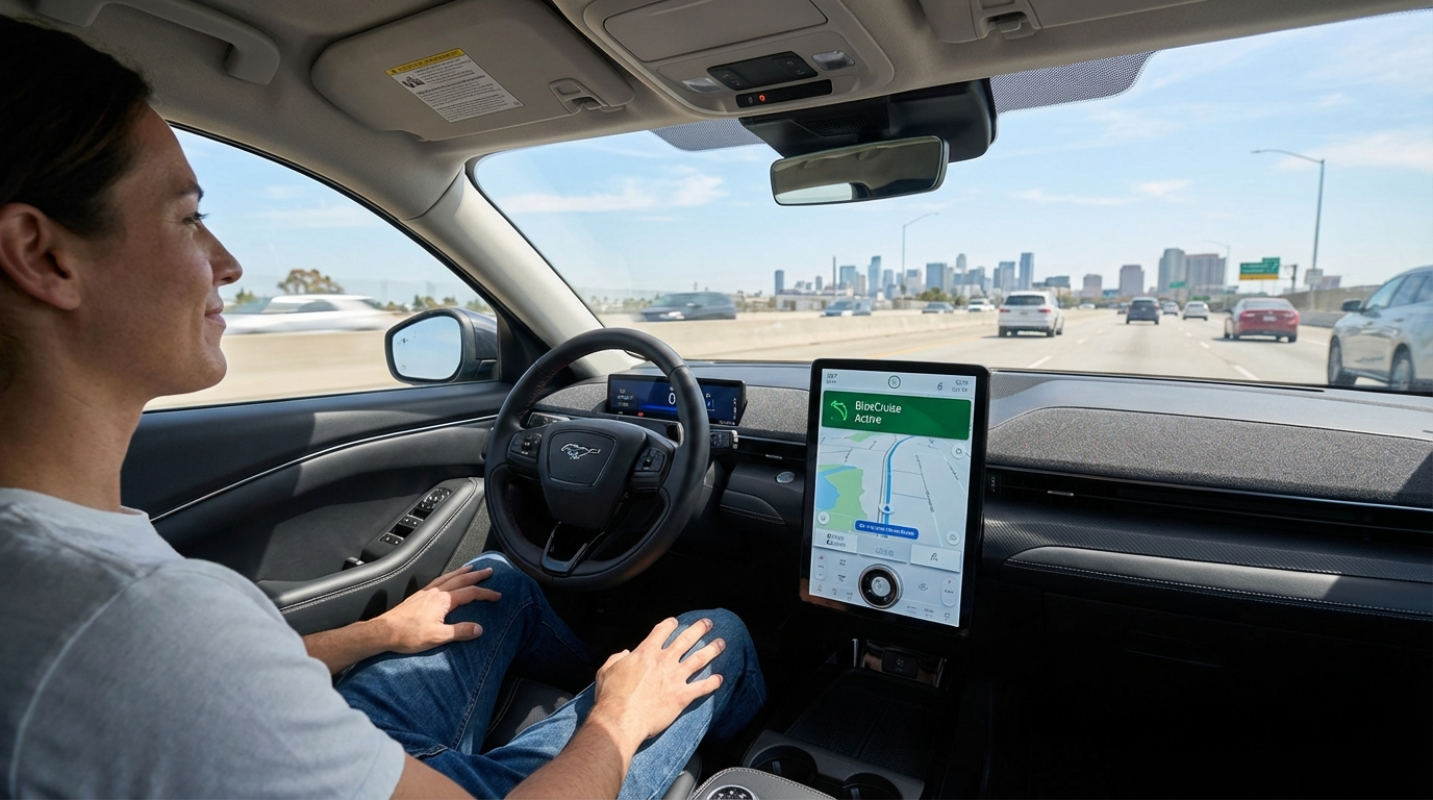
 You’ve probably seen the commercials. Someone is sitting in a Mustang Mach-E, hands behind their head, looking perfectly relaxed while the car zips along the highway at seventy miles per hour. It looks like the future, doesn't it? But as we sit here in 2026, the reality of hands-free driving is a bit more nuanced than a thirty-second TV spot.
Ford’s BlueCruise has been around for a few years now, and it has quickly become one of the most talked-about features in the electric vehicle world. The Mach-E was the pioneer for this tech, and it remains the poster child for Ford’s push into autonomy. But is it actually ready for prime time, or is it just a fancy party trick that loses its luster after the first week?
If you're looking at a Mach-E, the hands-free capability is likely a huge selling point. We’re going to look at how the system actually behaves when you're stuck in Friday afternoon traffic or cruising through a winding mountain pass. It’s one thing for a car to stay in its lane on a dead-straight road in Nebraska, but it’s quite another to handle the chaos of a modern interstate.
Understanding BlueCruise Technology and Prerequisites
Before you take your hands off the wheel, you need to understand what BlueCruise actually is. In technical terms, it’s a Level 2 plus system. That little "plus" is doing a lot of heavy lifting. It means the car can handle steering, braking, and acceleration, but you still have to be the boss. You can’t take a nap, you can’t watch a movie, and you definitely can’t climb into the back seat.
The system relies on a mix of radar and cameras to see the world around it. But the most important piece of hardware isn't looking at the road, it’s looking at you. There is an infrared camera sitting right on top of the steering column. This camera tracks your eye movement and head position to make sure you're actually paying attention. If you look away for more than a few seconds, the car is going to start complaining.
There’s also a catch regarding where you can use it. BlueCruise only works on what Ford calls Blue Zones. These are specific stretches of divided highways that have been meticulously mapped. As of early 2025, Ford had mapped about 130,000 miles of these roads across North America. If you aren't in a Blue Zone, the system reverts to standard lane-centering, which requires you to keep at least one hand on the wheel.
Real World Performance Highway Cruising and Stability
If you’ve ever used an early version of lane-keep assist, you know the "ping-pong" feeling. The car drifts toward the left line, jerks back to the right, and repeats the process until you feel seasick. Thankfully, with BlueCruise 1.3 and the newer 1.5 versions, that sensation is a thing of the past.¹ The Mach-E now holds the center of the lane with a level of confidence that feels almost human.
The acceleration and braking are equally smooth. In stop-and-go traffic, the Mach-E doesn't lurch forward or slam on the brakes like a nervous teenager. It feels natural. When someone cuts you off, the system reacts quickly but usually avoids the kind of panic-braking that scares the life out of you and the driver behind you.
Where things get interesting is in the curves. Earlier versions of the software would often give up and ask you to take over as soon as the road started to bend. The 2024 and 2025 models are much more capable. They can handle most highway curves without breaking a sweat. But if the curve is particularly sharp or the lane markings are faded, you’ll feel a slight vibration in the wheel, which is the car’s way of saying, "I’m not sure about this one, buddy."
The Human Factor Monitoring and Driver Engagement
Let’s talk about that driver-facing camera. It is incredibly strict. Think of it like a high school librarian who catches you whispering from across the room. Because it’s infrared, it can see your eyes even if you're wearing dark sunglasses. This is actually a good thing for safety, but it can be a bit annoying if you just want to check your navigation screen for a second.
The system is designed to mitigate fatigue, and it does a great job at that. By taking the micro-adjustments of steering off your plate, BlueCruise makes long road trips significantly less draining. You’ll arrive at your destination feeling much fresher than if you’d been wrestling with the wheel for four hours.
But the transition back to manual control can sometimes feel a bit abrupt. If the system encounters a construction zone or a section of road it doesn't recognize, it will beep and flash a blue light on the dash. You have a split second to grab the wheel and take over. It’s not a dangerous transition, but it does mean you can never truly "tune out." You are always the backup pilot.
Advanced Features and Comparison BlueCruise vs Competitors
In the 2024 Mach-E, you have access to Lane Change Assist. This is a bit of a "halfway" feature. If you want to change lanes, you tap the turn signal. The car then checks its blind spots and, if the coast is clear, it steers itself into the next lane. It’s cool, but it can be a bit timid. If there is a car anywhere near your rear quarter panel, the Mach-E will often hesitate or cancel the move entirely.
By comparison, the 2025 and 2026 models with BlueCruise 1.5 offer fully automatic lane changes.² The car can decide on its own to move into the left lane to pass a slower vehicle and then move back over when it’s done. This puts it on par with GM’s Super Cruise, which many consider the gold standard of hands-free tech.
How does it stack up against Tesla? It’s a different philosophy. Tesla’s Autopilot and FSD (Full Self-Driving) try to work everywhere, which leads to more "oops" moments. Ford’s BlueCruise is more restricted, but within those restrictions, it feels more polished and predictable. Ford users have already logged over 264 million hands-free miles, and that number is growing fast as more people realize how much stress it removes from the daily commute.³
Is the Mach-E Hands Free System Worth the Investment
So, what’s the bottom line? If you spend a lot of time on the highway, BlueCruise is a game changer. It’s the digital equivalent of a massage chair for your commute. The way it reduces mental load is something you don't fully appreciate until you go back to driving a car without it.
But it’s not perfect. The 2024 models are somewhat "locked in" to version 1.3 because of hardware limitations. If you want the latest and greatest automatic lane-changing features, you’ll need to look at the 2025 or 2026 models. There’s also the cost to consider. Ford has moved toward a subscription model for BlueCruise, which means you’ll be paying a monthly or yearly fee to keep the hands-free party going.
Is it worth it? For the casual driver who only hits the highway once a month, probably not. But for the road-tripper or the long-distance commuter, it’s one of the best features on the market today. It’s a mature, stable system that prioritizes safety over flashy maneuvers. Just remember: it’s an assistant, not a chauffeur. Keep your eyes on the road, and the Mach-E will handle the rest.
Sources:
1. Consumer Reports Ranks Active Driving Assistance Systems
2. Ford BlueCruise 1.5 Automatic Lane Change Details