 (Image source: Gemini / Landon Phillips)
 Imagine you're cruising down the interstate on a four-hour road trip. Your feet are flat on the floor because the car is handling the speed, and your hands are resting comfortably in your lap. You're still watching the road, but the physical fatigue of micro-steering for 300 miles is just gone.
It's 2026, and this isn't a futuristic dream anymore. It's a Tuesday.
We've officially entered the era of Level 2+ autonomy. You'll hear car companies throw around terms like "Full Self-Driving" or "BlueCruise," but it's important to know what we're actually talking about. These aren't robotaxis that let you sleep in the back seat. Those are Level 4 or 5 systems, and they're still mostly limited to specific city pilots. What we're comparing today are Level 2+ systems. They handle the steering, braking, and accelerating, but they demand that you remain the "captain of the ship," ready to take over at a moment's notice.
So, which brand actually makes your commute easier without making you feel like a test pilot? Let's break down the heavy hitters.
Tesla’s Vision and the Engagement Gap
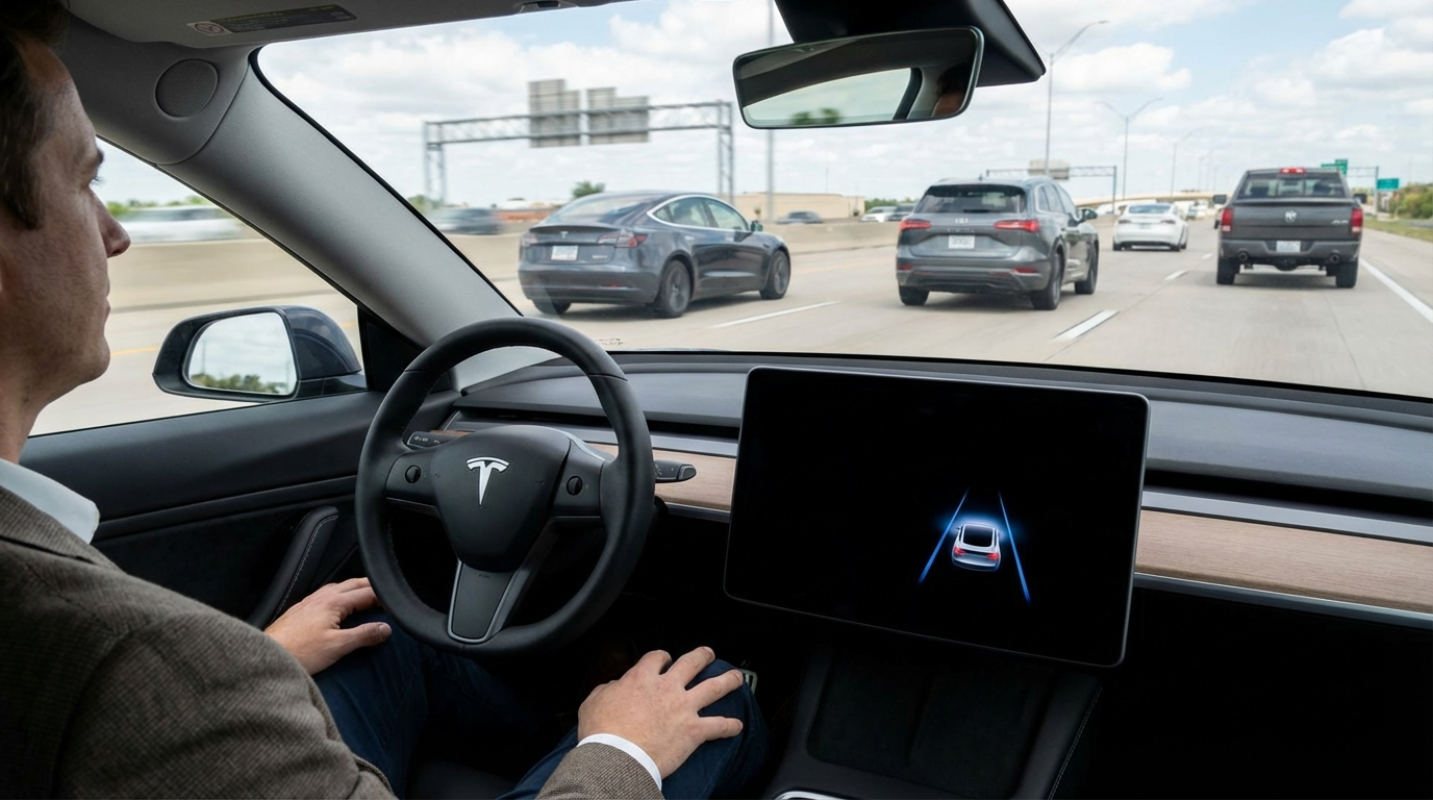
Tesla is the brand that started this whole conversation. If you buy a Tesla today, you're getting a car that views the world through eight cameras and a massive amount of artificial intelligence. They've famously ditched radar and ultrasonic sensors, betting entirely on "Vision."
The latest iteration, Full Self-Driving (FSD) Supervised v12.5, is a massive leap from where the tech was just a couple of years ago. It uses an end-to-end neural network, which is a fancy way of saying the car learned to drive by watching millions of hours of human video rather than just following lines of code.¹ What does that feel like for you? It feels more human. The car doesn't just jerk the wheel to stay centered, it flows.
But there's a catch. Tesla’s system is not geofenced. You can turn it on almost anywhere, from a well-marked highway to a winding back road with no lines. This sounds like a perk, but it’s a double-edged sword. Because the system tries to do everything everywhere, it can get confused by weird construction zones or complex intersections.
For a long time, Tesla owners had to "wiggle" the steering wheel every few seconds to prove they were paying attention. As of the most recent updates, Tesla has finally allowed for true hands-free driving on the highway, provided the internal cabin camera can see your eyes.¹ If you look down at your phone or start daydreaming, the car will beep at you faster than a microwave. It’s effective, but some drivers find it a bit like having a very nervous flight instructor sitting in the passenger seat.
The Map Dependent Leaders GM and Ford
Although Tesla tries to "see" its way through the world in real-time, GM and Ford take a much more calculated approach. They use high-definition (HD) maps. Think of it as the car having a cheat sheet for every inch of the road before it even gets there.
GM’s Super Cruise is widely considered the gold standard for highway relaxation. It doesn't just guess where the lane is, it knows exactly where the lane should be because a fleet of lidar-equipped planes and cars already mapped it. By 2026, GM has expanded this network to cover roughly 750,000 miles of highways across the US and Canada.² This includes everything from massive six-lane interstates to smaller, undivided state routes.
Ford’s BlueCruise is the direct rival, and it’s been winning a lot of fans lately. In fact, Consumer Reports has ranked it as the top active driving assistance system for two years running. Why? Because it’s predictable. Ford BlueCruise 1.4 introduced something called "In-Lane Repositioning."⁹ If you’re passing a massive semi-truck, the car will subtly shift itself toward the other side of your lane to give you more breathing room. It’s a small touch that makes a huge difference in how much you trust the machine.
The big difference here is the hardware used to watch you. Both GM and Ford use dedicated infrared cameras on the steering column. These cameras can see your eyes even through most sunglasses and in total darkness. They're much more strong than Tesla’s standard cabin camera. If you look away from the road, these systems are relentless. GM will even vibrate your seat to get your attention. It's a "tough love" approach to safety.
Direct Comparison of Usability and Hardware
When you're choosing between these, you have to look at how they handle the "real world" stuff like lane changes and construction.
- Lane Changes, GM Super Cruise is the king here. It can detect a slow car ahead, check the blind spot, move over, pass, and move back into the right lane without you doing a thing. Tesla FSD does this too, but it can sometimes be a bit aggressive. Ford BlueCruise usually requires you to tap the turn signal stalk to initiate the move.
- Road Coverage, Tesla wins on sheer availability because it isn't geofenced. But GM’s 750,000 miles of "Super Cruise" roads cover almost everywhere a normal person would actually want to go hands-free.² Ford is the most limited, focusing mostly on major divided highways.
- The Cost of Entry, This is where it gets spicy. Tesla’s FSD is a $99 per month subscription (at current rates), or a flat upfront fee. GM usually gives you three years for free, then asks for about $25 a month. Ford has moved toward a more expensive model, charging around $495 a year.⁹ You aren't just buying a car anymore, you're buying a software service.
- Handling the Unexpected, None of these systems are perfect. If you hit a construction zone where the lines are scrubbed out and replaced with orange cones, all three systems will likely "hand the keys" back to you. Tesla might try to handle it, which can be scary. GM and Ford will usually just give you a loud chime and tell you to take over immediately.
The Safety Reality Check
We can't talk about these systems without mentioning the "elephant in the room." Safety agencies are watching these technologies like hawks.
NHTSA has been breathing down Tesla’s neck for years, investigating hundreds of crashes where Autopilot was engaged.⁴ The concern isn't necessarily that the software failed, but that the drivers checked out mentally because the car felt "too good." Ford has also faced scrutiny recently following a couple of fatal nighttime crashes involving stationary vehicles.⁵
This is why the infrared eye-tracking in GM and Ford vehicles is so important. It prevents that "mental checkout." GM’s Super Cruise currently has the cleanest safety record of the three, with millions of miles driven and no publicly documented fatalities during active engagement as of mid-2024. That’s a huge selling point if you're putting your family in the car.
Which System Should Live in Your Garage
So, what does this actually mean for you when you're standing on the dealership lot? It depends on what kind of driver you are.
If you're a tech enthusiast who wants to see the absolute cutting edge of what AI can do, Tesla is your play. The way FSD handles a complex suburban neighborhood is genuinely mind-blowing. Just don't expect it to be a relaxing "set it and forget it" experience. You have to be "on" at all times because the system is unpredictable.
If you do a lot of long-distance towing or heavy interstate commuting, GM Super Cruise is the winner. The sheer polished feel of the system and the massive mapped network make it the most relaxing way to cross a state line. It feels like a professional chauffeur is handling the boring parts of the drive.
Ford BlueCruise is the middle ground. It’s incredibly safe, highly rated by independent testers, and the "In-Lane Repositioning" makes it feel the most natural of the three. It’s perfect for the person who wants the stress taken out of their daily highway commute but doesn't need the car to "drive itself" through a Taco Bell drive-thru.
Ultimately, the best system is the one that makes you feel the most confident. We're in a transitional period where the car is becoming a partner rather than just a tool. Whether you prefer Tesla’s "see everything" approach or the "map-everything" approach of Detroit, the result is the same: you're going to arrive at your destination a lot less tired than you used to.
Sources:
1. Tesla OTA 2024.20.10 FSD 12.5 Release Notes
2. GM to expand Super Cruise coverage
3. NHTSA concludes Tesla Autopilot investigation
4. NHTSA opens probe into Ford BlueCruise technology
5. A look at the 2024 Ford F-150 hands-free driving technology