 (Image source: Gemini / Landon Phillips)
 If you’ve been following the world of electric vehicles lately, you know that the conversation around Tesla usually starts and ends with three letters: FSD. It stands for Full Self-Driving, but as we sit here in 2026, the reality of that name is a bit more nuanced than the marketing might suggest. You’ve likely seen the viral videos of Model Ys navigating complex city streets without a human touching the wheel, but you’ve also probably heard the horror stories of sudden braking or confusing lane choices.
The Model Y is the most popular car on the planet for a reason, and for many owners, it serves as the primary test bed for Tesla’s most ambitious software. But what are you actually getting when you click that buy button? Is it a chauffeur in a box or just a really fancy cruise control?
This breakdown will look at what FSD offers your Model Y right now, how the hardware under the hood makes it possible, and whether the subscription is actually worth your hard-earned cash. We’re moving past the hype to look at the actual code and cameras that are trying to drive you to work.
The Hardware Foundation and the FSD Computer
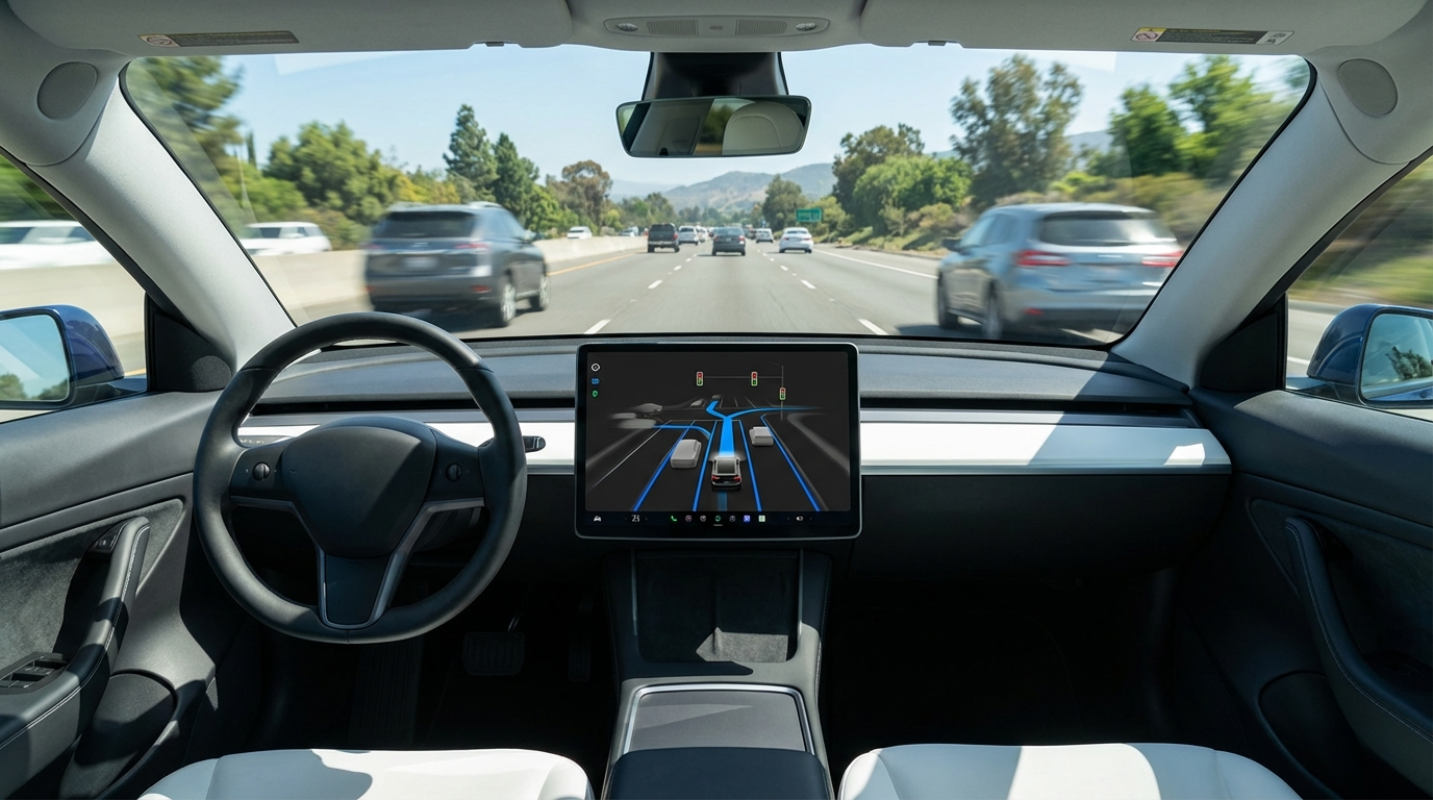
Tesla’s approach to self-driving is famously different from almost everyone else in the industry. Although companies like Waymo or Cruise use expensive Lidar sensors that bounce lasers off objects to "see" the world, Tesla relies almost entirely on "Tesla Vision." This means your Model Y is understanding the world using nothing but eight cameras and a massive amount of processing power.
If you bought a Model Y recently, you’re likely running on Hardware 4, which Tesla now calls AI4. This is a significant step up from the older Hardware 3 systems. The cameras in the AI4 suite are 5-megapixel sensors, which is a huge jump from the 1.2-megapixel cameras used in older units. These newer cameras have better dynamic range and a distinct red tint that helps them see more clearly in low-light or blurry conditions.
Inside the car, the FSD Computer (MCU3) is the brain doing all the heavy lifting. In the 2024 transition to v12 software, this computer stopped just following lines of code written by humans. Instead, it started running an end-to-end neural network. Think of it like this: rather than a programmer telling the car "if you see a red octagon, stop," the car watched millions of hours of video of humans driving and learned what to do by example.
This processing power matters because the car has to make thousands of decisions every second. The AI4 computer is roughly three to five times faster than the previous version, which gives the car more "thinking time" when things get chaotic on the road.
FSD Supervised vs Standard Autopilot and What You Get
It’s easy to get confused by the different tiers of Tesla’s software, especially since they changed the naming conventions recently. Every Model Y comes standard with Basic Autopilot. This gives you Traffic-Aware Cruise Control and Autosteer, which basically keeps you in your lane and maintains distance from the car in front of you on the highway. It’s great for long road trips, but it won't take turns or handle intersections.
FSD (Supervised), which Tesla formally renamed in early 2024 to remind everyone that a human still needs to pay attention, is a different beast entirely.¹ When you step up to this package, the car takes over almost every aspect of the drive.
- City Street Driving - The car handles turns, stops at lights, and handles through intersections without you needing to touch the pedals.
- Navigate on Autopilot - On the highway, the car will suggest lane changes to get around slow traffic and will even take the off-ramps for you.
- Actually Smart Summon (ASS) - This feature, which rolled out in late 2024, allows you to call your car from a parking spot using your phone.⁴ It’s much more reliable than the older versions and can handle complex parking lots to find you.
- Autopark - You can hop out of the car and let it tuck itself into a tight parallel or perpendicular spot.
The big difference is that while Basic Autopilot is a "stay in your lane" tool, FSD is a "get me to my destination" tool. But it still operates as a Level 2 system. That means legally and practically, you are the driver. You aren't a passenger yet.
The User Experience and Real World Performance
So, what does it feel like to actually use it? Since the release of v12, the driving style has become much more human. Earlier versions felt robotic and jerky, but the neural network architecture has smoothed things out significantly.³ The car now creeps forward at intersections to get a better view and handles speed bumps with a soft touch that feels much more natural.
One of the best updates for the Model Y was the removal of the "steering wheel nag." For years, you had to wiggle the wheel every few seconds to prove you were awake. Now, the cabin camera above the rearview mirror monitors your eyes. As long as you keep your eyes on the road, the car stays in control without you needing to touch the wheel constantly.
But it’s not perfect. There are still moments where the system gets confused. Unprotected left turns into heavy traffic can still be a white-knuckle experience. Construction zones with temporary cones or confusing hand signals from workers can also trip it up.
You’ve probably heard of "phantom braking," where the car slams on the brakes for no apparent reason. Although this has improved, it still happens occasionally when the cameras misinterpret a shadow or a bridge. It’s the digital equivalent of a person getting spooked by a rustle in the bushes. It’s better to be safe, but it can be jarring for you and the people driving behind you.
The Price of the Future and the Value for Today
The cost of FSD has been a bit of a roller coaster. In 2024, Tesla slashed the price from $12,000 down to $8,000 for a permanent purchase.⁵ More importantly for most people, they dropped the monthly subscription to $99. This move made it much more accessible for the average Model Y owner who might only want it for a month-long road trip.
Is it worth it? That depends on your commute. If you spend two hours a day in stop-and-go traffic, the $99 a month is arguably some of the best money you can spend on your sanity. The car handles the tedious parts of driving, leaving you less exhausted when you arrive.
But if you’re expecting to take a nap while the car drives you to work, you’re going to be disappointed. We’re still in the "Supervised" era. The safety stats are impressive, with Tesla reporting one crash every 7.63 million miles with FSD engaged compared to the US average of one every 0.67 million miles.⁶ But those stats only stay high because humans are there to take over when the AI gets confused.
The roadmap to true Level 4 or Level 5 autonomy, where you can actually look away from the road, is still a few years off. Regulatory scrutiny is high, especially with the NHTSA opening probes into how the system handles low-visibility conditions like fog or sun glare.
For now, FSD on the Model Y is the most advanced driver-assist system you can buy, but it’s still just an assistant. It’s a glimpse into a future where cars drive themselves, but for today, keep your hands near the wheel and your eyes on the road.
Sources:
1. Tesla formally drops FSD Beta moniker
2. Initial thoughts on FSD 12.5 after 100 miles of use
3. Tesla Full Self Driving version 12 reviews reveal highs and lows