 (Image source: Gemini / Landon Phillips)
 You finally did it. You traded the gas pump for a charging cable and joined the electric revolution. It feels great, doesn't it? But now that the initial excitement of instant torque has settled, you might be looking at that battery percentage and wondering how to make it last.
Your battery is the heart of your car. It is also, by far, the most expensive component you own. Think of your battery's State of Health (SOH) like a long-term savings account. Every time you charge, you are making a transaction. If you are smart about those transactions, your "account" stays full for hundreds of thousands of miles. If you are reckless, you might find your range and resale value dropping faster than you expected.
Maintaining that health is not just about being precious with a piece of technology. It is about protecting your investment. A car with a healthy battery is worth significantly more on the used market than one that has been abused by poor charging habits.
So what does this actually mean for you in 2026? The good news is that modern EVs are more resilient than the early models from a decade ago. But small, consistent habits still make a massive difference. You don't need to be a chemist to get this right. You just need to understand a few basic rules of thumb.
Mastering the 20% to 80% Sweet Spot
If there is one rule you should remember, it is the 20/80 rule. For most electric vehicles on the road today, the battery is happiest when it is somewhere in the middle. Why? Because lithium-ion batteries are a bit like us. They don't like being stuffed to the point of bursting, and they don't like being completely exhausted.
When you charge a battery to 100%, you are creating what engineers call voltage stress. At a high state of charge, the lithium ions are physically crowded into the anode. This can lead to something called lithium plating, where the lithium starts to form metallic deposits that permanently reduce the battery's capacity. On the flip side, letting the battery drop to 0% is equally stressful. It can cause physical strain on the electrodes as they contract.
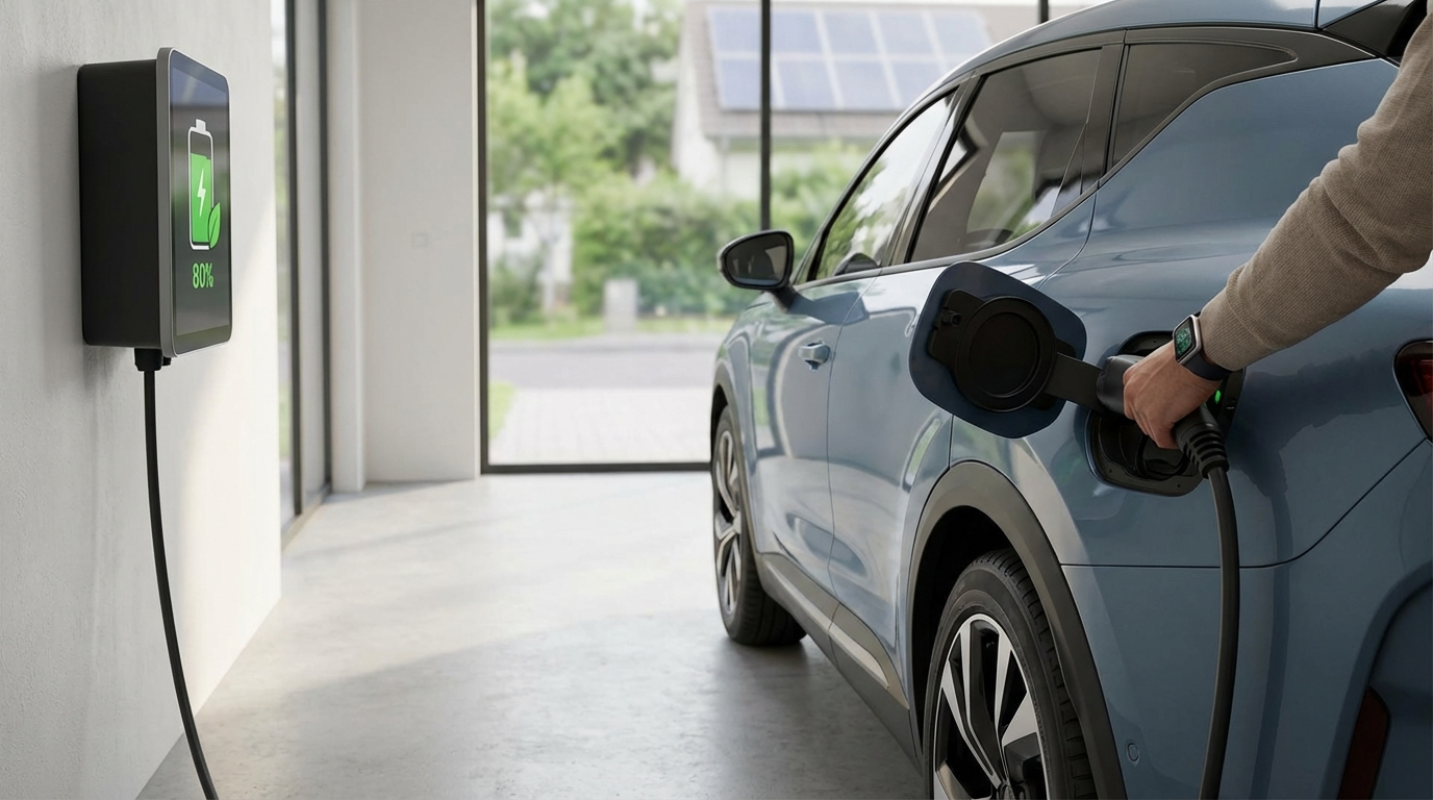
Most modern cars allow you to set a charging limit directly in the infotainment system or through an app. For your daily commute, set that limit to 80%. If you drive a newer Ford or Tesla with an NMC battery, you might even see guidance suggesting 90% is perfectly fine for daily use.²
Is it ever okay to hit 100%? Of course. If you are heading out on a long road trip, you want every mile of range you can get. The trick is timing. Don't let your car sit at 100% in your driveway for three days before you leave. Use the "scheduled departure" feature so the car hits 100% right as you are walking out the door. This minimizes the time the battery spends in that high-stress state.
Understanding Charging Speed
We all love the convenience of DC fast charging (DCFC). Being able to add 200 miles of range in twenty minutes feels like magic. But like most things that are fast and convenient, there is a trade-off.
Think of fast charging like a high-intensity sprint. It generates a lot of heat and forces energy into the battery cells at a rate that can be taxing over time. Recent data from 2025 shows that vehicles relying on fast chargers for more than 12% of their total charging sessions see faster degradation. Specifically, these cars might lose about 2.5% of their capacity per year, compared to just 1.5% for those who mostly use Level 2 home charging.
This doesn't mean you should avoid fast chargers entirely. They are needed for travel. But for your day-to-day life, Level 2 (AC) charging is your best friend. It is slower, cooler, and much gentler on the battery chemistry. If you have the ability to charge at home or work, that should be your primary fuel source.
Interestingly, some newer models from 2024 and 2025 have such advanced thermal management that the gap is narrowing. Data from Tesla Model 3 and Model Y owners suggests their batteries handle frequent fast charging better than almost any other car on the market. Still, the general rule remains: use the slow lane for daily life and save the fast lane for the highway.
Keeping Your Battery Cool and Warm
Temperature is the silent killer of battery capacity. Lithium-ion batteries have a "Goldilocks" zone where they operate best, usually between 70°F and 95°F. When you get outside of that range, things start to degrade.
In the heat of summer, try to park in the shade or in a garage. If your car is sitting in 100°F sun all day, the Battery Management System (BMS) has to work overtime to keep the cells cool. This uses energy and, if the cooling system can't keep up, accelerates chemical breakdown. Studies have shown that cars in consistently hot climates face a 0.4% annual degradation penalty compared to those in temperate areas.
Winter brings a different set of challenges. Cold batteries are less efficient and charge much slower. This is where "preconditioning" becomes your best friend. Most modern EVs allow you to warm up the battery while the car is still plugged into the wall. This means the car uses grid power, not battery power, to get the chemistry ready for the road.
Always use your in-car navigation when heading to a fast charger. The car will see that you are going to a charger and start preconditioning the battery so it is at the perfect temperature the moment you plug in. This prevents lithium plating and make sures you get the fastest, safest charge possible.
Managing Idle Time and Software Updates
What happens if you go on vacation and leave your car at home? This is a common point of anxiety for new owners. The worst thing you can do is leave the car sitting at 0% or 100% for a long period. If the battery is empty, it could potentially "brick" itself if the voltage drops too low. If it's at 100%, it sits in a high-stress state for weeks.
If you are leaving the car for a while, try to leave it at about 50%. This is the most stable state for the chemistry. Most manufacturers recommend keeping the car plugged in if possible, as the BMS can then use wall power to maintain the battery's health and temperature without draining the main pack.
Another easy win? Keep your software updated. In 2026, car manufacturers are constantly sending out "over-the-air" updates that improve how the BMS handles charging. These updates can actually extend the life of your battery by refining the charging curves and thermal management logic. It is the digital equivalent of a free tune-up.
Top Recommendations
If you want to get the most from your battery life without overthinking it, follow these simple steps. Consistency is more important than being perfect every single day.
- Know your chemistry: Check if your car has an LFP or NMC battery. LFP batteries (often found in standard range models) actually benefit from a 100% charge once a week to keep the range estimator accurate.¹
- Limit the speed: Try to keep your DC fast charging to less than 12% of your total charging sessions. Use Level 2 charging for your routine needs.
- Use the 80% rule: For daily driving, set your charge limit to 80% or 90% depending on your manufacturer's specific guidance.²
- Precondition in the cold: Always warm up your battery while plugged in during winter months to reduce strain on the cells.
Longevity Comes Down to Consistency
At the end of the day, you bought your EV to drive it, not to worry about it. Although these habits are important, don't let "range anxiety" or "degradation anxiety" ruin the experience. Modern EVs are incredibly strong. Most batteries hitting the road in 2025 and 2026 are expected to last 15 to 20 years, or well over 200,000 miles, before they even hit the 70% capacity threshold.
You don't need to be perfect. If you need to charge to 100% for a weekend trip, do it. If you have to use a fast charger three days in a row because you're busy, the car will handle it. These tips are about optimizing the long-term health, not preventing a sudden failure.
By sticking to the 80% rule, being aware of extreme temperatures, and favoring slower charging when you can, you are making sure that your car stays efficient and valuable for a long time. It is about making small, smart choices today so you can enjoy the ride for years to come.
Sources:
1. Optimum use of the LFP battery
2. 2025 Model 3 LR Highland LFP or NMC battery
3. Tesla Battery Comparison: NCA, NMC, LFP
This article on aidriv.com is for informational and educational purposes only. Readers are encouraged to consult qualified professionals and verify details with official sources before making decisions. This content does not constitute professional advice.