 (Image source: Gemini / Landon Phillips)
 You are sitting in your driveway, looking at your range estimate, and feeling a creeping sense of dread. Last year, a full charge promised you 250 miles. Today, it is showing 210. Your mind immediately goes to the worst case scenario: the battery is dying. You start picturing a five figure bill for a replacement pack and wondering if you should have just stuck with a hybrid.
Before you spiral, take a breath. There is a very good chance your battery is perfectly healthy. In the world of EVs, we often confuse "State of Health" (SOH) with "Efficiency." Your battery capacity is like the size of a fuel tank, while your efficiency is how fast you are burning through that fuel. If you have a hole in your pocket, you lose money, but that does not mean your bank account has been closed.
Diagnosing range loss starts with looking outside the battery pack. We need to talk about the invisible forces, the rubber on the road, and the software running behind the scenes. So what does this actually mean for your daily drive? Let's look at the three biggest reasons your miles are disappearing that have nothing to do with a failing battery.
The Aerodynamic Drag Culprit: Speed and Accessories
Physics is a harsh mistress, especially when you are trying to move a heavy object through a sea of air. Most people do not realize that at highway speeds, your car is basically fighting a brick wall. Aerodynamic drag increases with the square of your speed, which means doubling your speed actually quadruples the drag.
By the time you hit 62 mph, about 50 percent of the energy your car uses is just spent pushing air out of the way.¹ If you push that speed up to 75 or 80 mph, drag can account for as much as 70 percent of your total energy consumption. Recent data shows that jumping from 50 mph to 80 mph can slash your range by nearly 40 percent. If you have a lead foot on the interstate, you are paying a massive "speed tax" that has zero to do with your battery health.
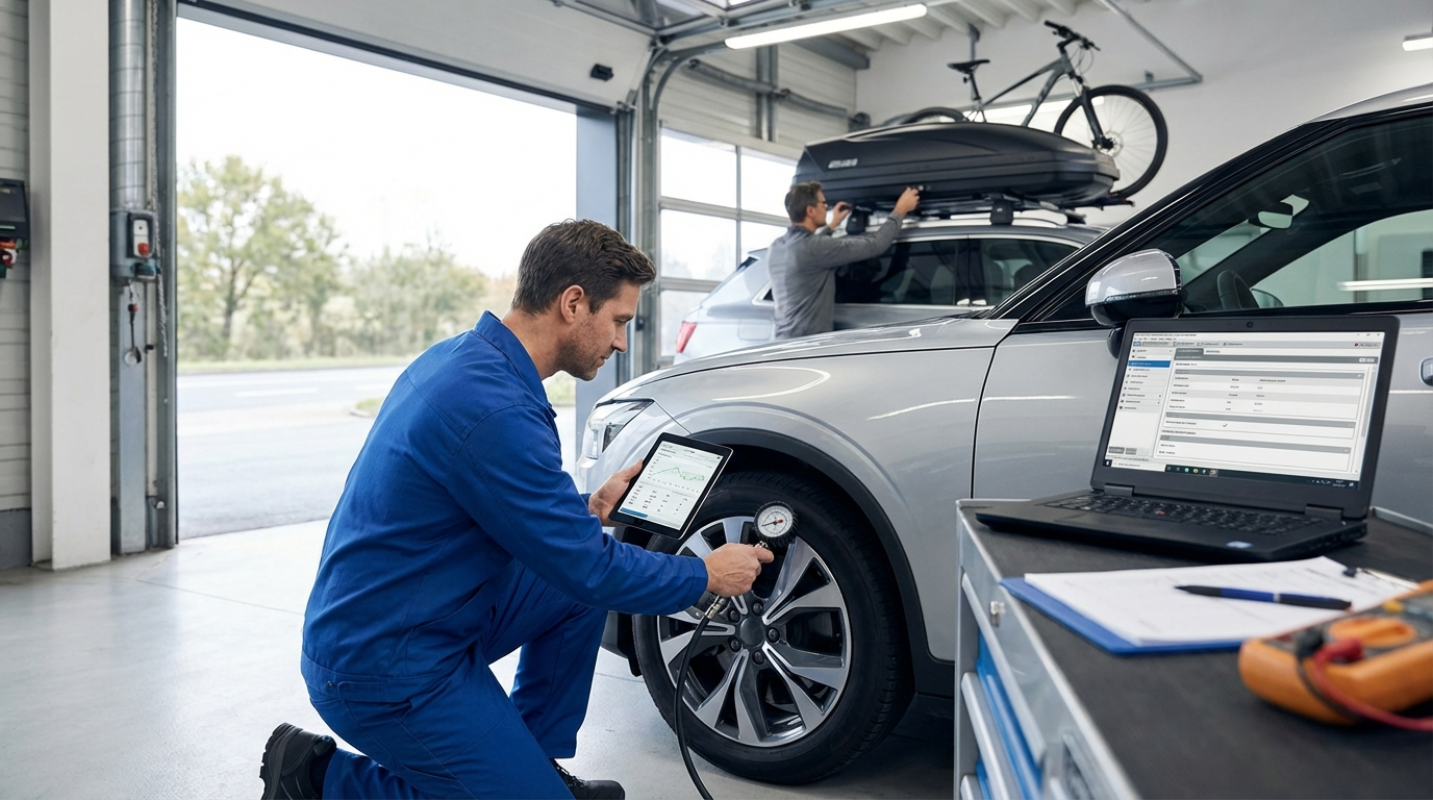
It is not just about how fast you go, but how "slippery" your car is. Have you added a roof rack recently? Or maybe a cargo box for a ski trip? These accessories are range killers. Even a set of empty crossbars can increase your drag coefficient enough to notice a 5 percent drop in efficiency.
You should also keep an eye on your car's active aero features. Many modern EVs use active grille shutters that open and close to balance cooling and aerodynamics. If these shutters get stuck open due to road debris or a motor failure, your car becomes less aerodynamic, and your highway range will take a hit. It is the digital equivalent of driving with your windows down all the time.
Tire Talk: Rolling Resistance and Pressure Management
If aerodynamics is the invisible wall, your tires are the friction point that can quietly steal your miles. Most EV owners do not think about their tires until they need a change, but the rubber you choose matters. EVs usually come from the factory with Low Rolling Resistance (LRR) tires. These are specifically designed to glide more easily.
If you recently replaced your tires with a "stickier" performance set or a cheaper non-LRR alternative, you might see an immediate 10 percent drop in range. Even if you bought the exact same model of tire, you might see a temporary dip. New tires actually have more rolling resistance than worn ones because the deep tread squirm creates more friction.² You usually have to "break in" new tires for about 500 to 1,000 miles before your efficiency returns to normal.
Then there is the issue of tire pressure. This is the easiest fix, yet it is the most common reason for "mysterious" range loss. Being under-inflated by just 5 to 10 PSI can increase rolling resistance by 20 percent. That translates to a 3 to 5 percent loss in total range.
Think of it like riding a bicycle with soft tires. You have to pedal much harder to maintain the same speed. Check your pressures every month, especially when the temperature changes. Cold air is denser, meaning your tire pressure drops as the thermometer does. This often leads people to blame the "winter battery" when the culprit is actually just low air pressure.
Climate Control and Auxiliary Load: The Hidden Energy Sinks
We have all heard that running the AC or heater kills range, but the scale of that impact can be shocking. Heating is a much bigger drain than cooling. In extreme cold, around 20 degrees Fahrenheit, you can lose about 41 percent of your range.³ This is not just because the battery is cold, but because keeping the cabin at 72 degrees requires a massive amount of energy.
If your EV uses an older resistive (PTC) heater, it is basically a giant toaster element. It is incredibly inefficient. Newer EVs use heat pumps, which are much better, but they still use power. If you find your range is lower than usual, look at your HVAC settings. Using the seat heaters and a heated steering wheel is much more efficient than cranking the cabin air temperature to the max.
Beyond the HVAC, you have to consider "vampire drain" and auxiliary loads. Your car is a rolling computer. It has infotainment systems, cameras, and constant cellular connectivity. If you have "Sentry Mode" or similar "always-on" features active, your car is constantly sipping power.
There is also the matter of pre-conditioning. If you start your car and blast the heat while it is not plugged in, you are taking that energy directly out of your driving range. Using vehicle telemetry or an OBD reader can help you see exactly how many kilowatts are going to the motor versus how many are being used by the "house" systems.⁴ If you see high auxiliary power usage while parked, you might have a background app or a 12V battery issue that is keeping the car "awake."
Software, Calibration, and Driver Behavior Adjustments
Sometimes, the range loss is not physical at all. It is mathematical. Your car's range estimate, often called the "Guess-O-Meter," is based on an algorithm that looks at your recent driving history. If you have recently changed your commute from flat city streets to hilly highways, the car will "learn" that you are less efficient and lower the estimate.
Software updates can also play a role. Manufacturers often tweak the algorithms that calculate range. A firmware update might make the estimate more "conservative" to prevent drivers from getting stranded. This looks like range loss on the screen, but the actual energy in the battery has not changed.
Regenerative braking is another factor. If you have recently changed your regen settings or if the car has limited regen because the battery is full or too cold, you will lose the ability to "recapture" energy. This forces you to use the friction brakes, wasting energy as heat instead of putting it back into the pack.
To truly diagnose what is happening, you need to stop looking at the "miles remaining" and start looking at your "Wh/mi" (Watt-hours per mile) or "mi/kWh." If your battery SOH is high but your Wh/mi has spiked, the problem is environmental or behavioral. Compare your summer efficiency to your winter data. If the efficiency drop correlates with the seasons, your battery is fine. It is just working harder to fight the elements.
Top Recommendations for Range Recovery
If you are seeing a dip in performance, try these steps before calling the dealer.
1. Check your tire pressure when the tires are cold and match the door jamb sticker exactly.
2. Remove any roof racks or heavy gear in the trunk that you are not using.
3. Use an OBDII scanner and a mobile app to check your actual State of Health (SOH) and cell balance.
4. Review your "Energy" app in the car to see the percentage of power used by "Climate" and "Driving."
5. Slow down by just 5 mph on the highway and watch your mi/kWh climb.
Improving your aerodynamics by just 5 percent is the equivalent of adding 3 kWh of battery capacity without adding any weight.⁵ Small changes in how you treat the car can lead to big gains in how far you can go.
Sources:
1. Geotab EV Efficiency Analysis
2. Tire Rack Rolling Resistance Study
3. Recurrent Auto Winter Range Report
4. iNetic Traction Auxiliary Load Breakdown
5. Stellantis Engineering Efficiency Report
This article on aidriv.com is for informational and educational purposes only. Readers are encouraged to consult qualified professionals and verify details with official sources before making decisions. This content does not constitute professional advice.