 (Image source: Gemini / Landon Phillips)
 You probably remember the anxiety of your first smartphone. After a year of heavy use, the battery barely made it to dinner time. Now, you have a 1,000-pound battery sitting in your driveway, and you are likely wondering if your electric vehicle (EV) will become a very expensive paperweight in a decade. It is a valid concern. After all, batteries are living chemistry experiments.
Battery degradation is a fancy way of describing two things: capacity fade and impedance rise. Capacity fade means your "gas tank" gets smaller over time. Impedance rise means it becomes harder for the battery to push energy out, which can slightly sap your performance. So what does this actually mean for you? It means that while your car will lose some range as the years pass, it is rarely a sudden death. It is more like a slow, predictable marathon.
The good news is that we are seeing incredible data from the field as we move through 2026. Recent studies show that modern battery management systems (BMS) are doing a much better job than the early pioneers did. According to a major study by Geotab that analyzed over 5,000 vehicles, the average degradation rate has dropped to just 1.8% per year.¹ That is a massive improvement from the 2.3% we saw just a few years ago. Most batteries are now projected to last 20 years or over 200,000 miles.²
You can't stop aging entirely. Calendar aging happens even if the car just sits there. But the way you treat the battery during those years makes the difference between a car that loses 10% of its range and one that loses 30%. It is about managing thermal stress, cycle life, and how you handle the daily charge.
The Thermal Tightrope, Mastering Temperature Management
Think of your battery like a person. It is happiest when it is comfortable. If you are shivering or sweating, your battery is probably struggling too. The "Goldilocks Zone" for lithium-ion health is surprisingly narrow, usually between 15°C and 27°C (60°F to 80°F).
When things get hot, the chemistry inside the cells gets aggressive. Operating your car at 45°C (113°F) can actually cut the expected life of the battery in half compared to keeping it at a cool 20°C. High heat accelerates the chemical reactions that break down the internal structures of the battery. If you live in a scorching climate, you are fighting a tougher battle than someone in a temperate one.
So how do you fight back? First, use your garage. It sounds simple, but a shaded spot or a climate-controlled garage is the best gift you can give your EV. Second, trust the Thermal Management System (TMS). Modern cars use liquid cooling to keep the cells stable. If you leave your car plugged in during a heatwave, the car can use wall power to run the cooling pumps without draining the battery itself.
Winter presents a different challenge. Freezing temperatures don't necessarily "kill" the battery permanently, but they make it much harder to move energy around. This is why preconditioning is your best friend. By using your app to warm up the car while it is still plugged in, you make sure the battery is at an ideal temperature before you even pull out of the driveway. This reduces the "cold-start" strain that can lead to long-term wear.
Charging Habits, State of Charge Optimization for Longevity
If there is one rule you should live by, it is the 80/20 rule. For most EVs on the road today, keeping the battery between 20% and 80% is the secret to a long life. Why? Because batteries hate being stuffed to the gills or run down to empty.
When you charge to 100%, you are creating high voltage stress. It is the digital equivalent of over-inflating a balloon. This can lead to something called "lithium plating," where lithium ions turn into metallic lithium on the surface of the anode. Once that happens, those ions are gone forever, and your capacity drops. Unless you are heading out on a long road trip, set your charge limit to 80%.
But you need to know what kind of battery you have. This is where it gets interesting.
- NMC (Nickel Manganese Cobalt), These are common in long-range models. They are sensitive to heat and high charge levels. Stick to the 80% rule religiously.
- LFP (Lithium Iron Phosphate), These are the "tanks" of the battery world. They are much more durable and can handle 3,000 to 5,000 cycles.³ If you have an LFP battery, like those in the standard range Tesla Model 3, you should actually charge to 100% at least once a week to help the car calibrate its range sensors.
What about fast charging? We all love the convenience of a DC fast charger, but it is like a diet of pure espresso. It is fine for a boost on a trip, but it shouldn't be your daily routine. Frequent fast charging can increase annual degradation to about 3.0%, whereas sticking to Level 2 (AC) charging at home keeps it closer to 1.5%.
Cycle Management and Storage, Handling Inactivity and High Utilization
What happens if you go on vacation for a month? You might think leaving it at 100% so it is "ready to go" is the right move. It isn't. Leaving a battery at a high state of charge for weeks is one of the fastest ways to age it. If you are heading out, leave the car at about 50% or 60%. This is the "zen" state for lithium-ion chemistry where internal stress is at its lowest.
You also want to think about "cycles." A cycle is one full discharge and recharge. Most modern batteries are rated for at least 1,000 to 2,000 full cycles before they hit 80% capacity. But here is a trick: shallow cycles are better than deep ones. Using 10% of your battery and topping it back up to 80% is much easier on the chemistry than running it down to 5% and then charging it all the way back up.
Real-world driving is actually better for your battery than lab tests might suggest. A 2025 study found that the stop-and-go nature of driving, which includes regenerative braking, helps keep the ions moving in a way that can extend life by up to 40% compared to steady-state testing.² Don't be afraid to drive the car. Just be smart about the extremes.
Top Recommendations, Managing Your Battery Health
Warranty Software and Future-Proofing Your Investment
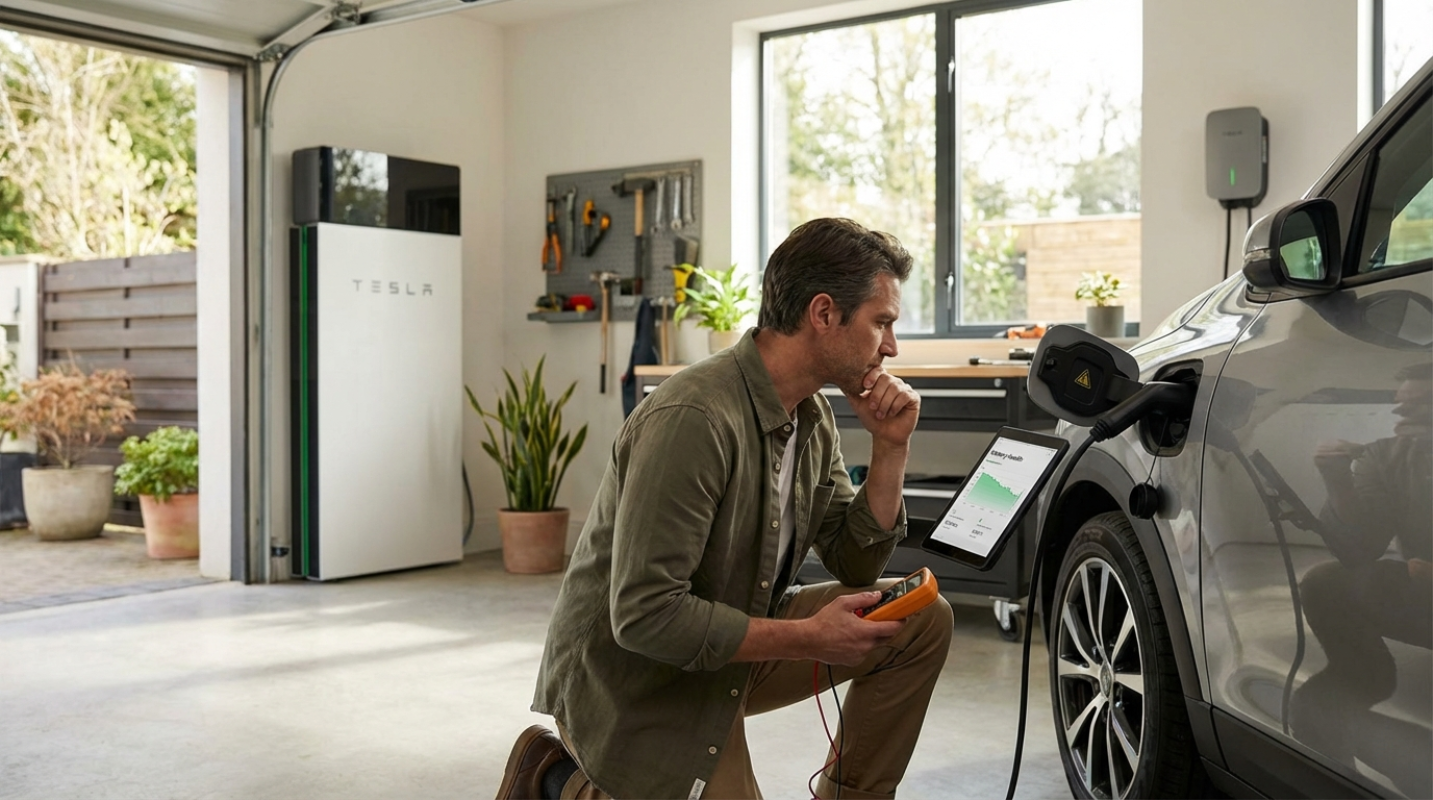
The industry has moved from passive monitoring to what I call "predictive management." In 2026, your car is likely smarter than you realize. Like, Tesla recently introduced a user-accessible Battery Health Test in their 2025.8.3 software update.⁴ You can now run a 16-hour diagnostic that measures exactly how much energy your pack can hold and recalibrates the system for better accuracy.
Hyundai and Kia have also stepped up with AI-driven analytics. Their newest systems can detect tiny cell faults weeks before they become a problem.⁵ This kind of software-led protection means that the "catastrophic failure" people used to fear is becoming incredibly rare.
If you are worried about resale value, keep your records. A well-maintained battery is a massive selling point. We are also seeing a growing market for "second-life" applications. Even when a battery is too weak for a car (say, at 70% capacity), it is still perfect for home energy storage. This keeps the residual value of your vehicle higher than you might expect.
Summary of Expert Recommendations for Long-Term Ownership
- Daily SoC: Limit to 80% for NMC batteries or 100% weekly for LFP.
- Parking: Prioritize shade or garages to avoid extreme heat soak.
- Charging Speed: Use Level 2 AC charging for 90% of your needs.
- Pre-conditioning: Always warm or cool the battery while plugged in before driving.
- Storage: If leaving the car for more than a week, set the charge to 50%.
Managing a battery isn't about being paranoid. It is about building a few simple habits that protect your biggest investment. If you follow these steps, there is a very good chance your battery will still be humming along long after the rest of the car has seen better days.
Sources:
1. Geotab EV Battery Degradation Study
2. Nature Energy 2025 Real-World Battery Longevity Report
3. LFP vs NMC Battery Comparison 2025
4. Tesla Introduces Battery Health Test in 2025.8.3 Update
5. Hyundai Kia Unveils AI BMS Battery Technology
This article on aidriv.com is for informational and educational purposes only. Readers are encouraged to consult qualified professionals and verify details with official sources before making decisions. This content does not constitute professional advice.