 (Image source: Gemini / Landon Phillips)
 If you have spent any time behind the wheel of an electric car lately, you know it is a different world than it was just a few years ago. By now, in 2026, most of us have realized that owning an EV is not just about plugging it in and driving. It is about understanding the chemistry under your floorboards. You might have noticed that your smartphone acts up when you are out skiing or sitting on a sweltering beach. Your car is a giant version of that phone, and it is just as sensitive to the weather.
The heart of your vehicle, the Lithium-ion battery, is a lot like a marathon runner. It performs its best when the temperature is just right, specifically between 15°C and 35°C (59°F to 95°F).¹ When you push it outside of that comfort zone, things get complicated. Although modern EVs are equipped with sophisticated thermal management systems that work hard behind the scenes, your habits as a driver still play a massive role in how well that battery holds up over time.
So what does this actually mean for you? It means that preparing for a polar vortex or a record-breaking heatwave is the difference between a car that lasts fifteen years and one that starts showing its age after five. We have seen some incredible tech leaps recently, but the fundamentals of battery care remain the same.
Conquering the Cold , Winterizing Your Electric Vehicle
Winter is notoriously tough on EVs. You have probably heard the horror stories about range dropping by 30% or 40% as soon as the frost hits the windshield. It is not just your imagination. Cold weather increases the internal resistance within the battery cells, making them feel sluggish. Think of it like trying to stir cold honey. It just does not want to move.
The most important tool in your winter arsenal is a feature called preconditioning. If you are not using your car's app to schedule your departure, you are leaving range on the table. When you tell your car you are leaving at 8:00 AM while it is still plugged into your home charger, the vehicle uses grid power to warm up the battery and the cabin. This is a huge win because it saves the energy stored in the battery for actual driving.
We also have to talk about the "Chicago Deep Freeze" of 2024. That event taught us a hard lesson about charging frozen batteries. If a battery is too cold, it cannot safely accept a high-voltage charge. This leads to a phenomenon called lithium plating, where lithium ions get stuck on the surface of the anode rather than soaking in. It causes permanent damage. If you are heading to a fast charger in sub-zero temps, always use your car's navigation to "route" to the charger. This tells the car to start aggressively heating the battery so it is ready to gulp down power the moment you plug in.
When you are actually on the road, try to heat the human, not the air. Your cabin heater is an energy hog. In contrast, your heated seats and steering wheel use about ten times less power. If you are worried about making it to your destination, turn the cabin temp down and crank the seat heater up. It is a simple trade that can save you miles of range.
Battling the Heat , EV Summer Preparedness and Protection
Although the cold makes your car less efficient, the heat is actually more dangerous for the battery's long-term health. High temperatures accelerate the chemical reactions that lead to permanent capacity loss. In fact, vehicles kept in consistently hot climates degrade about 0.4% faster every year than those in milder areas.¹
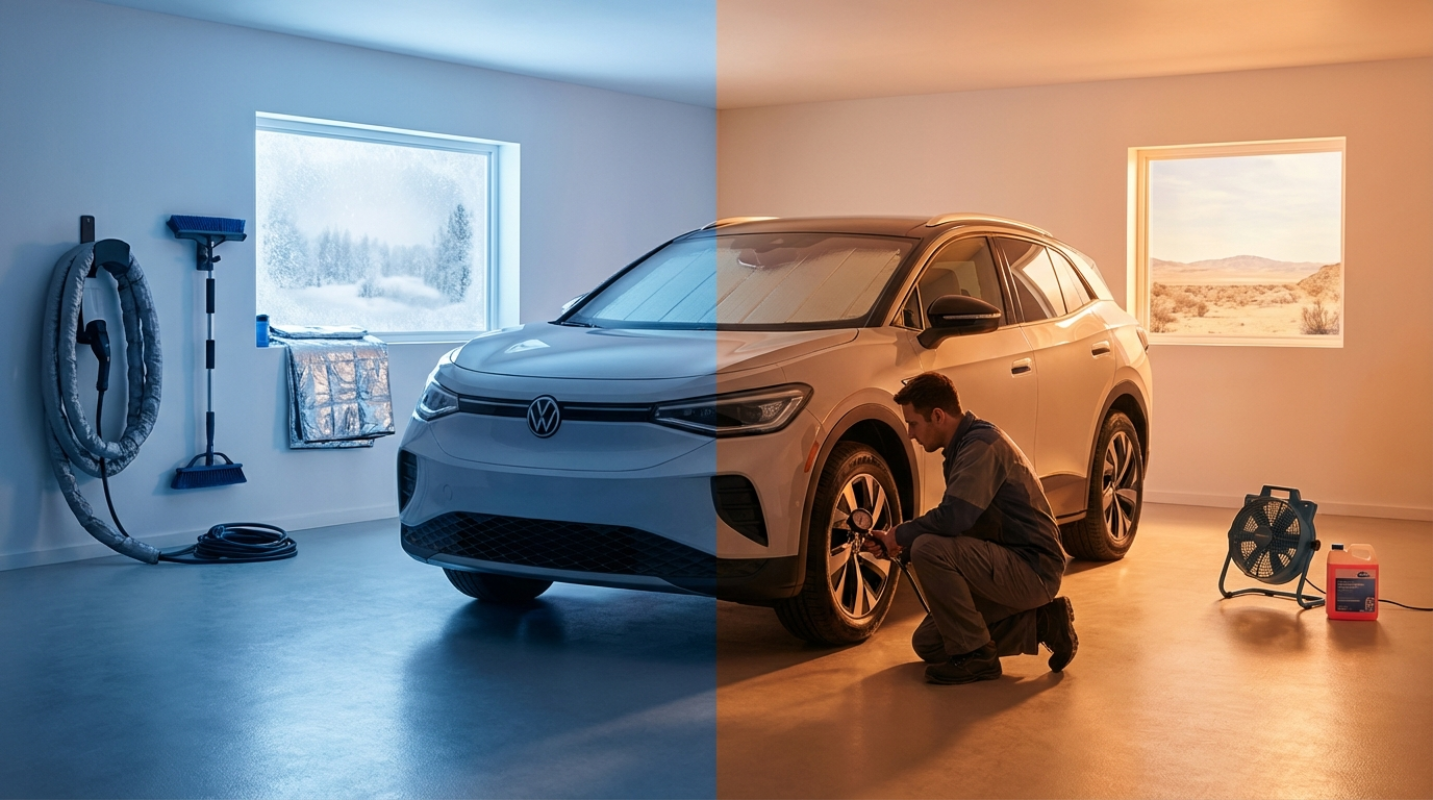
The best thing you can do during a 2026 summer heatwave is to find some shade. It sounds simple, but parking in direct sunlight can raise your battery temperature by 10 to 15 degrees above the ambient air. If you cannot find a parking garage or a leafy tree, invest in a high-quality reflective sunshade for your windshield. It keeps the cabin cooler, which means your car does not have to work as hard to blast the AC when you get back in.
Charging habits need to shift when the mercury rises too. Avoid what I call "hot charging." If you just finished a long, high-speed highway run, your battery is already cooking. If you immediately plug into a DC fast charger, you are piling heat on top of heat. Give the car twenty or thirty minutes to breathe and let the cooling fans do their job before you start a high-power charge.
Also, keep an eye on your tires. We often talk about tire pressure in the winter, but extreme heat causes the air inside your tires to expand. Over-inflated tires can lead to uneven wear and reduced traction. It is worth checking your pressures once a month during the summer to make sure you are staying within the manufacturer's recommended range.
Charging Protocols , Adapting Your Routines Seasonally
Your charging routine should not be a "set it and forget it" situation. In 2026, we have seen that the "sweet spot" for battery health is keeping your state of charge between 20% and 80%. This is especially true in extreme weather. High voltage combined with high heat is a recipe for degradation. During the summer, try to limit your daily charge to 80% unless you absolutely need the full range for a road trip.
In the winter, the rules change slightly. Although you still want to avoid sitting at 100% for long periods, you should try to keep the car plugged in as often as possible. Most modern EVs (especially those from Tesla, Hyundai, and Ford) are designed to use wall power to run internal heaters. If the car is plugged in, it can keep itself from freezing without draining the battery.
Level 2 charging (your standard home wall box) is generally better than Level 1 (a regular wall outlet) during extreme cold. A standard 120V outlet often does not provide enough "juice" to both heat the battery and charge it at the same time. If it is -10 degrees outside, a Level 1 charger might spend all its energy just trying to keep the battery from freezing, leaving you with zero net gain in range by morning.
Beyond the Battery , Needed Non-Powertrain Checks
It is easy to get obsessed with the battery, but your car has other systems that need love when the weather turns extreme. The thermal management system relies on coolant, just like an internal combustion engine. But in an EV, this coolant is often responsible for keeping the battery, the motor, and the power electronics at the right temperature. Have your coolant levels and condition checked annually.
Your HVAC system also needs a check-up. The air conditioning in an EV is not just for your comfort. It is often integrated into the battery cooling loop. If your refrigerant is low, your AC might blow cold enough for you, but it might not be able to pull enough heat away from the battery during a fast charge.
Finally, do not forget the basics. Winter-specific wiper blades and de-icing washer fluid are needed. In 2026, many EVs come with "scavenging" heat pumps that capture waste heat from the motor to warm the cabin, which is brilliant tech, but it still cannot clear a frozen windshield as fast as a good old-fashioned ice scraper.
Top Recommendations
Mastering the Seasons for the Long Haul
At the end of the day, your electric vehicle is a remarkably strong piece of machinery. The technological leaps we have seen recently, such as AI-driven battery management systems and immersion cooling, have made these cars much more capable of handling the elements. But even the smartest AI cannot replace good ownership habits.
Taking a few extra minutes to park in the shade or scheduling your departure time might seem like a hassle at first, but these small actions pay huge dividends. You are not just preserving your range for today. You are protecting the resale value and the lifespan of your car for the next decade.
Always remember to check your specific owner's manual. Every manufacturer has its own secret sauce for thermal management, and what works for a Tesla might be slightly different for a Rivian or a Hyundai. Stay proactive, keep it plugged in, and your EV will treat you well, no matter what the thermometer says.
Sources:
1. Geotab EV Battery Degradation Study
2. Idaho National Laboratory, EV Cold Weather Performance
3. Recurrent Auto, EV Winter Range Loss Report
4. Xing Mobility, Immersion Cooling Technology Data
5. Department of Energy, Getting the most from Electric Car Range