 (Image source: Gemini / Landon Phillips)
 You probably love the feeling of your EV slowing down the moment you lift your foot. It’s efficient, it saves your brake pads, and it feels like you’re finally driving in the future. Regenerative braking, or regen, is one of those mechanical marvels that makes electric car ownership feel so rewarding. But have you ever stopped to think about what that constant tugging is doing to your interior?
Although we’ve spent years praising regen for extending range, we’ve mostly ignored its impact on the cabin. It turns out that aggressive one-pedal driving habits are creating a brand-new category of accelerated cabin aging. It isn't just about how you drive; it's about how your car’s interior reacts to your driving style.
Understanding the mechanics of frequent, aggressive regen use reveals how it contributes to premature wear on specific parts of your car. From the stitching in your seats to the clips holding your dashboard together, your efficiency habits might be costing you in resale value. This guide looks at why this happens and how you can keep your cabin looking new while still reaping the benefits of EV tech.
The Physics of One-Pedal Driving and Its Interior Toll
Think of aggressive regenerative braking as the digital equivalent of a physical tug-of-war between your motor and your upholstery. When you lift off the accelerator in a high-regen setting, the vehicle can produce deceleration forces ranging from 0.15g to 0.3g. Sound like a small number? In the world of interior physics, it’s a constant, repetitive jolt.
Traditional braking is often smoother and more gradual because we’ve been trained for decades to modulate a physical pedal. With one-pedal driving, many drivers treat the accelerator like an on-off switch. This jerky motion causes frequent, rapid weight shifts for everyone inside. Every time the car tugs during deceleration, you and your passengers shift forward and then back into the seat.
This creates constant micro-abrasions between your clothing and the seat material. It’s not just a comfort issue. It’s a mechanical stressor for seat bolstering, seatbelt tensioners, and even your floor mats. When the car decelerates sharply, your body weight moves, and the materials holding you in place have to absorb that energy over and over again.
The Driver's Seat and Floor Mat Syndrome
The driver’s seat is the primary victim of your regen habits. Because you are the one anticipating the deceleration, you often brace yourself by pushing into the bolsters or the floor. Experts have noted that the vegan leather used in most 2026 EVs is more susceptible to crease-set than traditional hides when subjected to these frequent, high-pressure shifts.¹
If you drive a Tesla Model 3 or Model Y, you might have already noticed this. Owners have reported significant bolster creasing and stitching pull in as little as 12,000 miles. These raised wings on the side of the seat are designed to hold you in place during high-torque acceleration, but they get crushed when you slide forward during aggressive regen. It’s a multi-axial stress that leads to premature cracking of the synthetic topcoat.
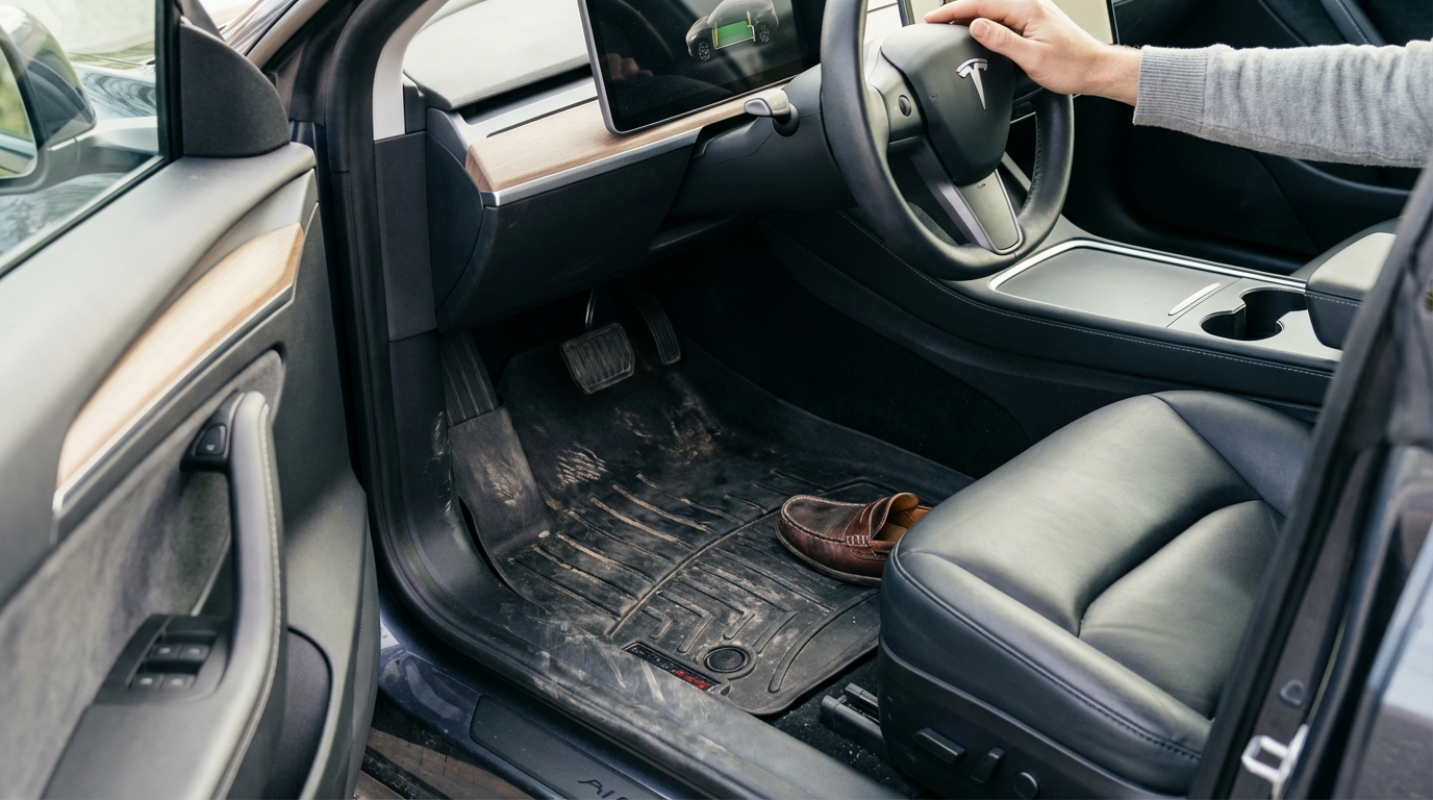
Then there’s the floor mat problem. In a one-pedal setup, the accelerator becomes the regen pedal. You’re constantly shifting your foot position to modulate the speed. This leads to micro-abrasions or large shifts in driver-side mats. If you’re using standard carpet mats, you’ll likely see a hole worn through near the heel pivot point much faster than in a gas car. Choosing high-quality, custom-fit floor liners that lock into place is a smart move to prevent this displacement.
Dashboard and Console Integrity
You might think your dashboard is safe, but it’s actually under constant pressure from your footwork. Many drivers have developed a brake pedal stomp habit. Even if regen handles most of the work, drivers often reset the system or panic-stop by tapping the friction brake. This sudden transition leads to knees knocking against the center console or shins hitting the lower dash.
Hard acceleration recovery is another factor. The quick transition from full regen back to full torque can cause items left unsecured on the dashboard or center console to slide or fall. Over time, these small impacts leave scuffs and scratches on the plastic and trim. It’s the repetitive nature of these movements that does the damage.
The silent nature of your EV also makes interior noises more noticeable, but the physical act of aggressive regen may actually create them. Constant toggling between high-torque acceleration and high-torque deceleration puts repetitive stress on plastic interior clips. Automotive journalists have noted that one-pedal enthusiasts report a higher frequency of mystery rattles in the center console. This is attributed to the repetitive loading and unloading of the vehicle's frame, which can slightly loosen interior fasteners over a few years of ownership.
Best Practices for Balancing Efficiency and Longevity
So how do you save your range without destroying your seats? It starts with training your muscle memory. You should treat the accelerator like a dimmer switch rather than a toggle. Easing off the pedal slowly reduces the G-force impact on your passengers and your upholstery. It’s about being more anticipatory with your lift-off.
You should also be smart about your settings. Use standard or low regen on highways where you don’t need frequent deceleration. Reserve the high-regen, one-pedal mode for stop-and-go city traffic where it’s actually doing the most work for your battery. There’s no reason to subject your interior to 0.3g of force every time you exit a freeway.
Regular maintenance of your interior materials matters. Applying a ceramic coating specifically designed for synthetic leathers can reduce the friction coefficient of the material. This allows your clothing to slide more easily during deceleration rather than grabbing and stretching the fabric. Also, remember the cup of coffee rule. If your regen habit would spill a full cup of coffee on the dash, you’re driving too aggressively for the longevity of your cabin.
Driving Smarter and Preserving Your Cabin
At the end of the day, regenerative braking is a tool, and like any tool, it can be used with precision or with brute force. The goal isn't to stop using one-pedal driving entirely. It’s about recognizing that the way you interact with that pedal has a direct line to the physical condition of your car’s interior.
Small changes in your footwork can yield significant long-term preservation. By smoothing out your deceleration, you aren't just making the ride more comfortable for your passengers; you’re literally stopping your seats from tearing themselves apart. As EV designs evolve, we’ll likely see more durable materials and better mounting points, but for now, the responsibility lies with the driver.
Next time you lift off the pedal, think about that forward slide. Is it worth the extra 0.1% of battery gain if it means a cracked bolster in two years? Probably not. Drive smart, modulate your speed, and your cabin will stay as quiet and crisp as the day you drove it off the lot.
Sources:
1. Genuine Leather vs. Vegan Leather, A Deep Dive into Durability and Aging
2. Out of Spec Studios, Detailing and EV Interior Wear Analysis 2026
3. Szoneier Leather, Synthetic Material Friction and Abrasion Reports
4. RED Corporate Training, Fleet Management and EV Driver Habits