 (Image source: Gemini / Landon Phillips)
 Remember that twenty dollar code reader you keep in your glove box? It is great for telling you why your old truck has a check engine light because of a loose gas cap. But if you try to plug that same tool into a 2026 Tesla Model 3 or a Ford Mustang Mach-E, you are going to feel like you are trying to read a modern novel through a keyhole. You might see some basic data, but you are missing ninety percent of the story.
The shift from internal combustion engines (ICE) to battery electric vehicles (BEV) has fundamentally changed what it means to "scan" a car. In the old days, we were looking for air, fuel, and spark. Today, you are dealing with high-voltage (HV) architecture, complex thermal management loops, and software that decides how much torque to send to a motor in milliseconds. If you are a technician or a serious enthusiast, you have to realize that the scan tool is the new wrench. Without the right digital access, you are basically flying blind.
Why Traditional OBD-II Isn't Enough for EVs
The OBD-II port was originally designed for emissions monitoring. Since EVs don't have tailpipes, the standard protocols that every cheap scanner uses are almost useless for deep diagnostics. Sure, you can still pull basic "P" codes for generic faults, but the real meat of the vehicle lives in proprietary CAN bus networks and secure gateways.
Think of it like this. A traditional scanner speaks a universal dialect of "Car." An EV-specific diagnostic tool speaks the specific, highly technical language of the manufacturer. When you are dealing with a 400 volt or 800 volt system, "generic" data isn't just unhelpful, it can be dangerous. You need to see exactly what the Battery Management System (BMS) is thinking, not just a "system okay" message. The necessity for specialized tools has never been higher as we move into a world where software updates can change a car's performance overnight.
The Core Components Requiring Specialized Scanning
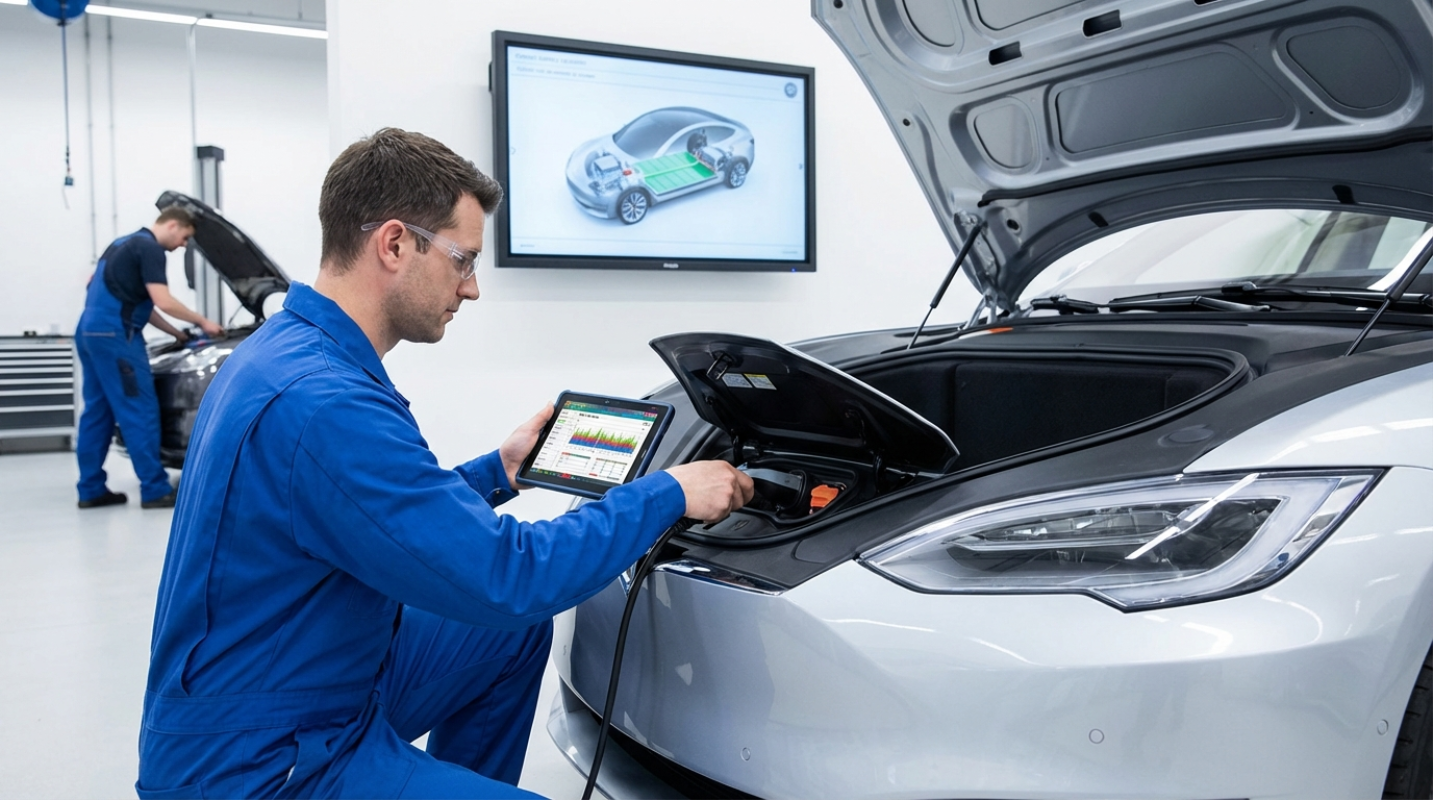
When you hook up a professional-grade EV scanner, you aren't just looking for error codes. You are looking at the pulse of the high-voltage system. There are three big areas where you need deep visibility.
Battery Management System (BMS) Health
The BMS is the most important computer in the car. It is responsible for keeping thousands of lithium-ion cells from destroying themselves. When you scan an EV, you are looking for the State of Health (SoH). In 2026, the industry standard for a "good" battery is still anything above 80 percent.¹ If it drops below 70 percent, you are usually looking at a warranty claim or a serious conversation with the owner about range loss.
But the real secret is in cell balancing. You want to see a voltage variance of less than 40mV between the highest and lowest cells. If you see a gap of 100mV or more, you have a important failure brewing. A specialized scan tool lets you see these individual cell voltages in real-time. It is the difference between knowing the battery is "fine" and knowing that module number four is about to give up the ghost.
Inverter and Drive Unit Diagnostics
The inverter is the bridge between the DC battery and the AC motor. It uses high-speed transistors to "chop" electricity and create motion. When something goes wrong here, a standard scanner won't tell you why. An EV-specific tool allows you to monitor torque requests and thermal management feedback. You can actually see if the inverter is getting too hot or if the gate drivers are failing before the car leaves you stranded on the highway.
High Voltage Isolation and Safety
This is the safety stuff that keeps you from getting electrocuted. EVs use isolation monitoring to make sure that the high-voltage system isn't "leaking" electricity into the chassis of the car. The "Golden Rule" for 2026 is 500 ohms per volt. If you have a 400V system, your isolation resistance must be greater than 200,000 ohms. A specialized scan can trigger an isolation test to verify the system is safe before you even put your hands on a high-voltage cable.
Needed EV Diagnostic Tools and Software Ecosystems
So, what should you actually have in your shop? The space is split into three tiers.
1. OEM Software . This is the gold standard. Tools like Tesla Toolbox 3, Ford FDRS, or GM GDS2. These give you the power to flash firmware, "brick" or "unbrick" modules, and perform battery conditioning. The catch? They are expensive. A Tesla subscription can run you $3,000 a year or $100 for a single day of access.²
2. Professional Aftermarket Tools . This is where most independent shops live. Tools like the Autel MaxiSYS MS909EV or the XTool N9EV are designed specifically for EVs. They come with high-voltage breakout boxes and can talk to multiple brands. They are great for about 80 percent of the work, like pulling SoH reports and doing basic resets.³
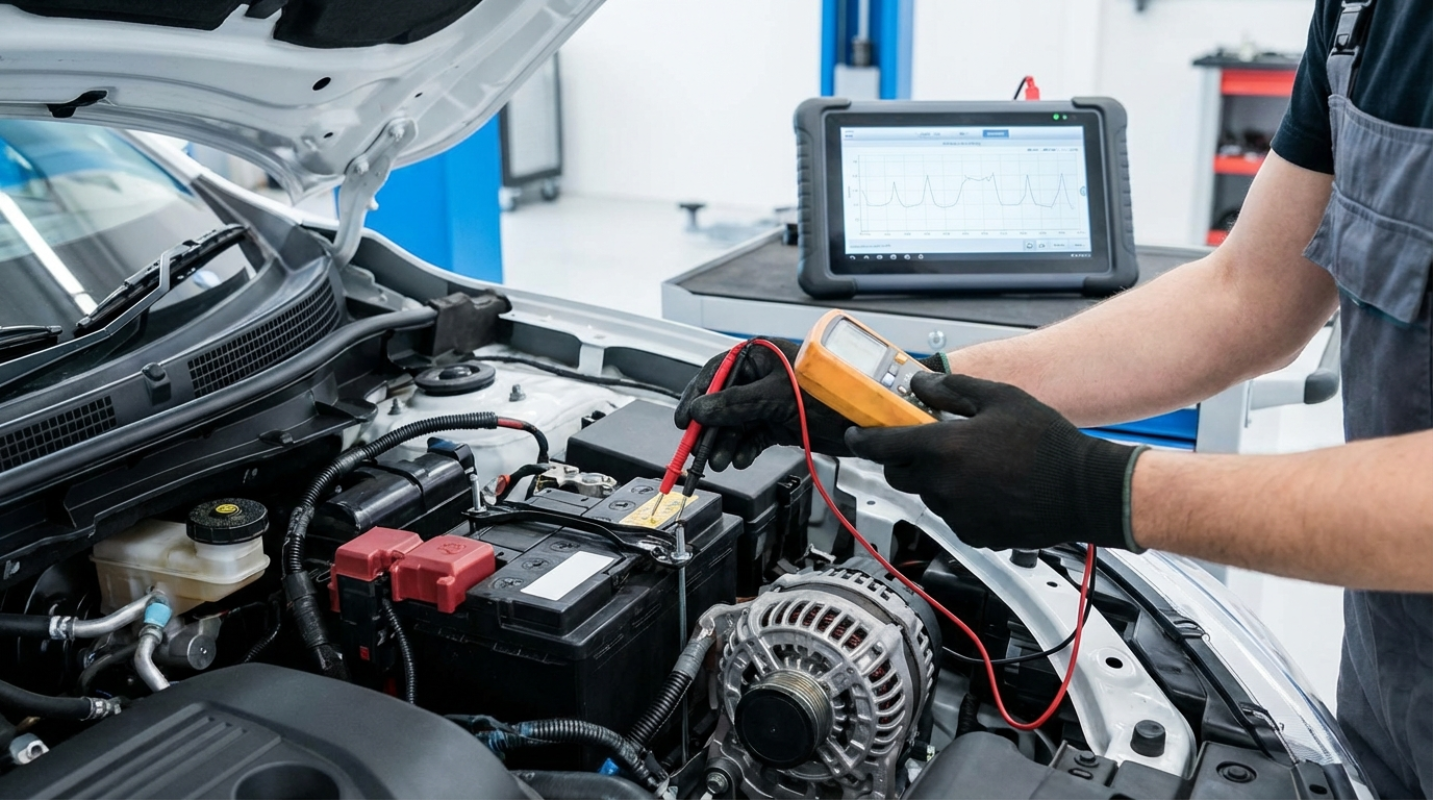
3. Specialized Hardware . You cannot do this with a screen alone. You need a high-quality insulation tester like the HIOKI IR4059 and an oscilloscope like a PicoScope. These tools let you see the actual physical signals that the software is reporting.
Decoding Common EV Fault Codes and Repair Approaches
When you see a code like P0A80 (Replace Hybrid/EV Battery Pack), don't panic. In the EV world, a code is just a starting point. Often, these errors are caused by a single bad sensor or a software glitch rather than a total hardware failure.
The first thing you should do is check for firmware updates. We are seeing more and more "repairs" that consist of nothing more than a laptop and an internet connection. If the software is out of date, the BMS might misinterpret a voltage sag as a hardware failure.
Charging system faults are another big one. If a car won't DC fast charge, the problem is often a communication error between the car and the charger. A good scan tool will let you look at the "handshake" process. You can see exactly where the conversation breaks down. Is the car asking for power? Is the charger refusing? You won't find that info in a generic code list.
The Path Toward 2030 Mastery
The days of being "just a mechanic" are over. To survive in the repair environment of 2026 and beyond, you have to embrace the role of a data analyst. Manufacturers are making this harder by implementing Secure Gateways (SGW) and cloud-based authentication. This is the "Death of the Clone" era. You can no longer rely on pirated software from a shady website; the cars now check with the home server before they allow a scan to happen.
If you want to stay relevant, start investing in training now. Focus on understanding vehicle networks and high-voltage safety protocols. The "Right to Repair" movement is fighting to keep this data accessible, but for now, the advantage goes to the person who knows how to interpret a voltage curve and a data stream.
The transition to EVs isn't something to fear. It is just a different set of symptoms and a different set of tools. Once you learn to "read" the battery and the inverter, you'll realize that these cars are actually much more logical to diagnose than a leaky, vacuum-lined internal combustion engine. You just need the right digital key to unlock the door.
Sources:
1. Battery State of Health Standards 2026
2. Professional EV Scan Tool Overview
3. OEM vs Aftermarket Tools in the Modern Shop
This article on aidriv.com is for informational and educational purposes only. Readers are encouraged to consult qualified professionals and verify details with official sources before making decisions. This content does not constitute professional advice.