 (Image source: Gemini / Landon Phillips)
 You just picked up your shiny new electric vehicle and the silence is golden. No engine vibration, no gear shifts, just smooth power. But then, about 8,000 miles in, you notice something annoying. Your tires look like they've been through a war zone. You might be thinking, "I haven't even hit a pothole, so why are the shoulders of my tires bald already?"
Standard wheel alignment is one of those things we’ve always taken for granted with gas cars. You get it checked when you buy new tires or if the steering wheel feels a bit crooked. But in 2026, we’re realizing that EVs are a completely different animal. The old rules don't quite apply anymore.
The reality is that electric cars put a level of stress on their suspension and tires that would make a traditional sedan crumble. If you treat your EV alignment like you treated your old Honda Civic, you’re basically throwing money out the window. So what makes these cars so demanding? Let's get into why your EV needs a specialized touch.
Weight Distribution and Instant Torque, The Dual Stressors
The first thing you have to understand is the "Battery Burden." It’s no secret that EVs are heavy. A Tesla Model 3 weighs about 800 pounds more than a comparable gas-powered sedan, and a Ford F-150 Lightning can be 1,600 pounds heavier than its internal combustion cousin. All that weight comes from the battery pack sitting low in the chassis.
Although a low center of gravity is great for handling, it’s brutal on your suspension. This constant mass puts extreme pressure on your bushings and ball joints. Technicians are now seeing "suspension settling" much earlier than they used to. In many cases, an EV's alignment can drift out of spec within the first 5,000 miles just because the suspension is compressed under that massive static load.
Then there’s the "Traction Tax." You love that instant torque, right? That feeling of 100 percent power hitting the pavement the second you touch the pedal is addictive. But every time you launch, your tires are experiencing microscopic levels of slip. If your alignment is even slightly off, specifically your toe settings, that torque acts like a belt sander. It "scrubs" the tread off your tires at an accelerated rate. A recent study from 2024 showed that EV owners are seeing tires wear out 15 to 30 percent faster than expected because of this torque-alignment combo.
Tire Technology and Low Rolling Resistance, A Mismatch in Wear Patterns
If you’ve looked at the price of EV-specific tires lately, you know they aren't cheap. These tires are engineered with specialized compounds for low rolling resistance to help you squeeze every mile out of a charge. They also have higher load ratings (look for the HL mark) to support the battery weight.
Because these tires are designed to be efficient, they are also incredibly sensitive to alignment. Even a tiny deviation in camber or toe can cause "feathering" or "cupping." This isn't just a maintenance issue, it's an efficiency issue. In 2026, shops are starting to market alignment as "Range Recovery," and for good reason.
Think of it like this. A mere 2mm of toe misalignment is the physical equivalent of dragging your tire sideways for 24 feet every single mile. That creates massive drag. Expert testing has shown that poor alignment can slash your total range by 5 to 10 percent. If you have a 300-mile range, you’re losing 30 miles per charge just because your wheels aren't pointing straight.
Suspension Geometry and Ride Height Complexities
Aligning an EV isn't as simple as putting it on a rack and turning a few bolts. Many modern EVs, like the Rivian R1T or the Tesla Model S, use adaptive air suspension. This adds a whole new layer of complexity. If a technician tries to align a Rivian while it’s in "Conserve" or "Sport" mode, the geometry will be completely wrong once the car adjusts its height on the highway.
Specific manufacturer requirements have become much more stringent. Like, Tesla’s service manuals for 2025 and 2026 models often require "weighted alignments." This means the technician has to place 150 pounds of ballast in each front seat to simulate a driver and passenger.¹ Without that weight, the alignment won't reflect how the car actually sits on the road, leading to inaccurate geometry.
There’s also the issue of adjustment points. Some popular models, like the Tesla Model 3 and Model Y, don't even have dedicated factory adjustment points for camber or caster.² To get these cars back into spec, technicians have to "manipulate suspension lash," which involves loosening subframe bolts and physically shifting the components. It’s a job that requires a lot more finesse than your local "quick-lube" shop is used to providing.
Best Practices, What EV Owners and Technicians Must Know for 2026
If you want to keep your EV running efficiently and avoid buying new tires every year, you need to change your maintenance mindset. The days of "set it and forget it" are over.
- Frequency matters, You should be getting your alignment checked every 6,000 to 10,000 miles. Because of the weight and torque, things move faster than you’d expect.
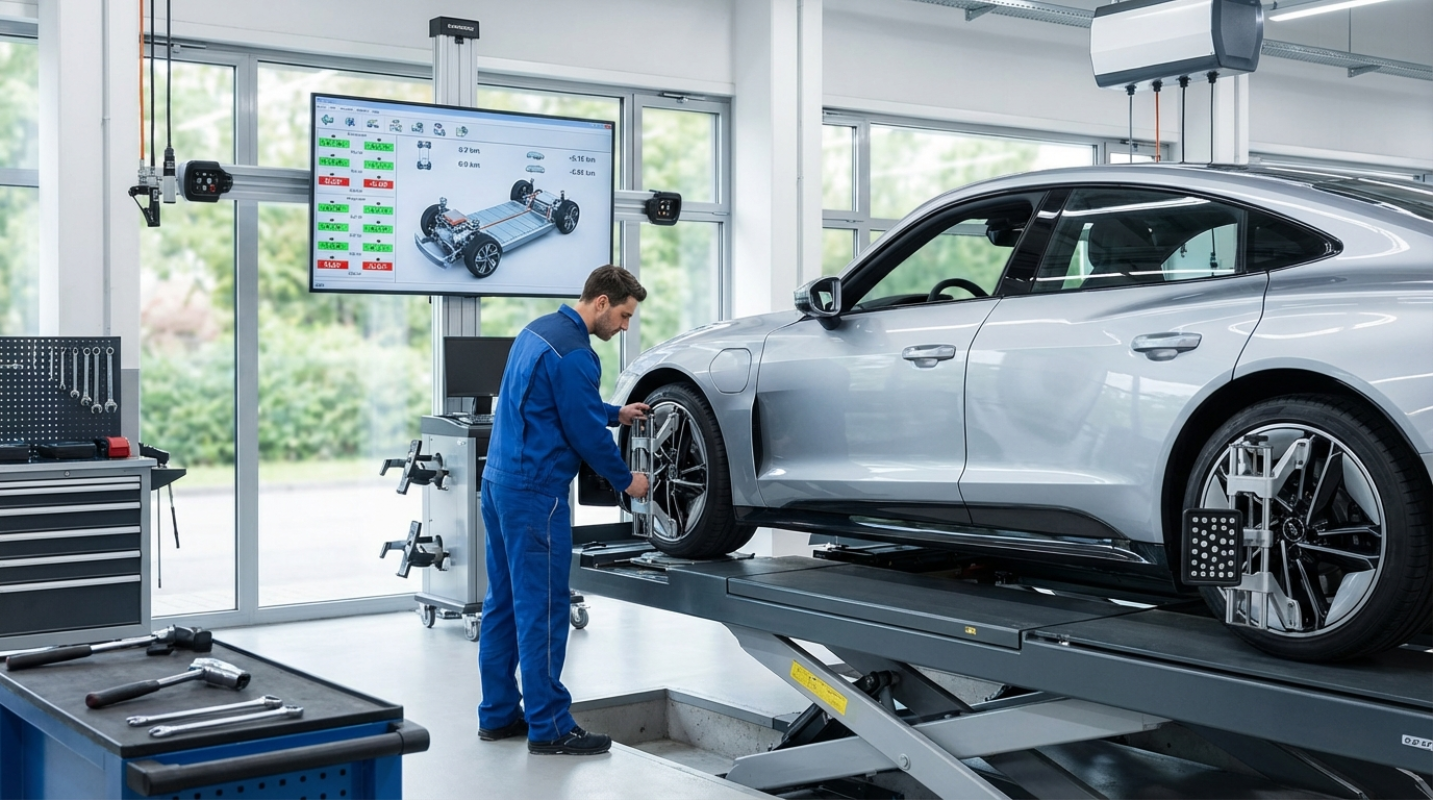
- Demand 3D technology, Make sure the shop uses modern 3D alignment racks with software databases updated for 2026 models. Hunter Engineering and other leaders frequently push updates to account for the unique suspension "lash" of new EVs.
- ADAS is part of the job, This is a big one. Almost every alignment on a modern EV must be followed by an ADAS (Advanced Driver Assistance Systems) calibration. Your lane-keep assist and emergency braking sensors rely on the "thrust angle" of your wheels. If the wheels are adjusted but the sensors aren't recalibrated, your car might think it's drifting when it isn't.
- Check your load index, If you’re replacing tires, never settle for "standard" tires. Putting a tire with a lower load rating on a heavy EV will cause the alignment to drift as the sidewalls flex and sag under the battery's weight.
Top Recommendations for EV Alignment Service
When you're looking for a service center, don't just ask about the price. Ask about their experience with your specific brand. A Ford F-150 Lightning requires a complete steering geometry reset that a technician who only works on gas trucks might skip. Similarly, a Kia EV9 has different tolerances depending on whether it was manufactured in the US or Korea, requiring cloud-based software updates to get the specs right.
At the end of the day, an electric vehicle is a high-performance computer on wheels that happens to weigh three tons. It’s a marvel of engineering, but it’s also demanding. By staying on top of your alignment, you aren't just saving your tires. You're saving your range, your safety, and your wallet.
Sources:
1. Tesla Model 3 Service Manual, Wheel Alignment
2. Tesla Model Y Service Manual, Alignment Specifications
3. ASE xEV Safety Standards and Certifications